doris@jshnbuzzer.com

Piezoelectric vs Electromagnetic Buzzer: Ultimate Guide
 Oct 19, 2026|
 View:5
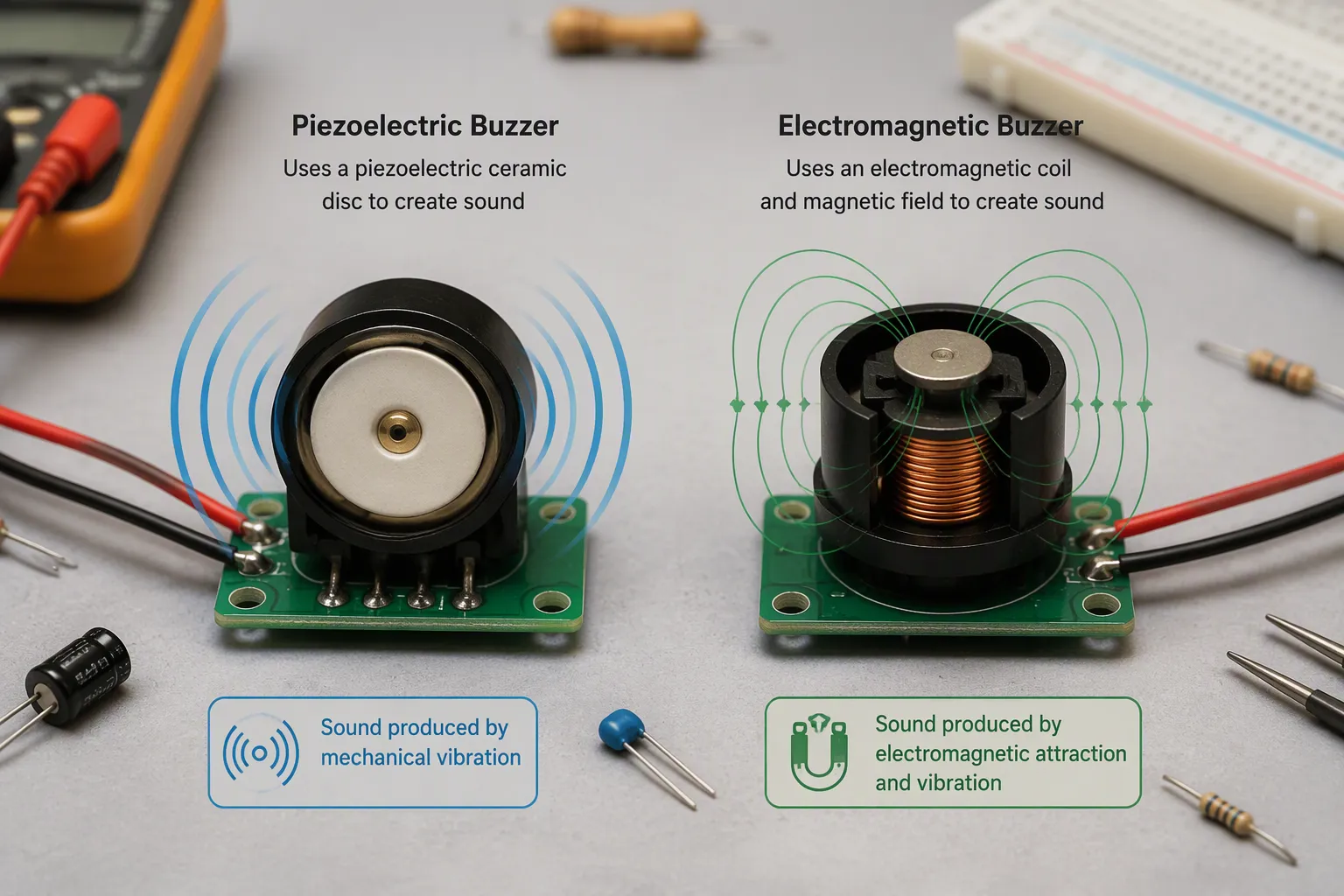
Neither buzzer type is universally better. The right choice depends on your application's voltage, current budget, sound output requirements, and environmental conditions. The two technologies differ fundamentally: A piezoelectric buzzer uses a ceramic element driven by voltage and behaves electrically like a capacitor. An electromagnetic buzzer uses a coil and magnet to drive a diaphragm and behaves electrically like an inductor. That single difference shapes almost every specification that follows. The piezoelectric vs. electromagnetic buzzer decision becomes manageable once you understand these mechanisms. Working principles, key specifications, and a step-by-step selection process give you a clear path. Match each factor to your design requirements, and you can choose with confidence.
Key Takeaways
Piezoelectric buzzers draw minimal current (typically under 10 mA) and operate across a wide voltage range (3 V to 250 V).
Electromagnetic buzzers produce richer, fuller sound and deliver louder output at low voltages (1.5 V to 12 V).
Choose piezoelectric buzzers for battery-powered IoT devices, wearables, and high-frequency safety alarms.
Choose electromagnetic buzzers for low-voltage applications requiring a pleasant, steady tone such as doorbells and UI feedback.
Always match the buzzer type to your supply voltage, current budget, acoustic target, and available PCB space.
Piezoelectric vs. Electromagnetic Buzzer: The Short Answer
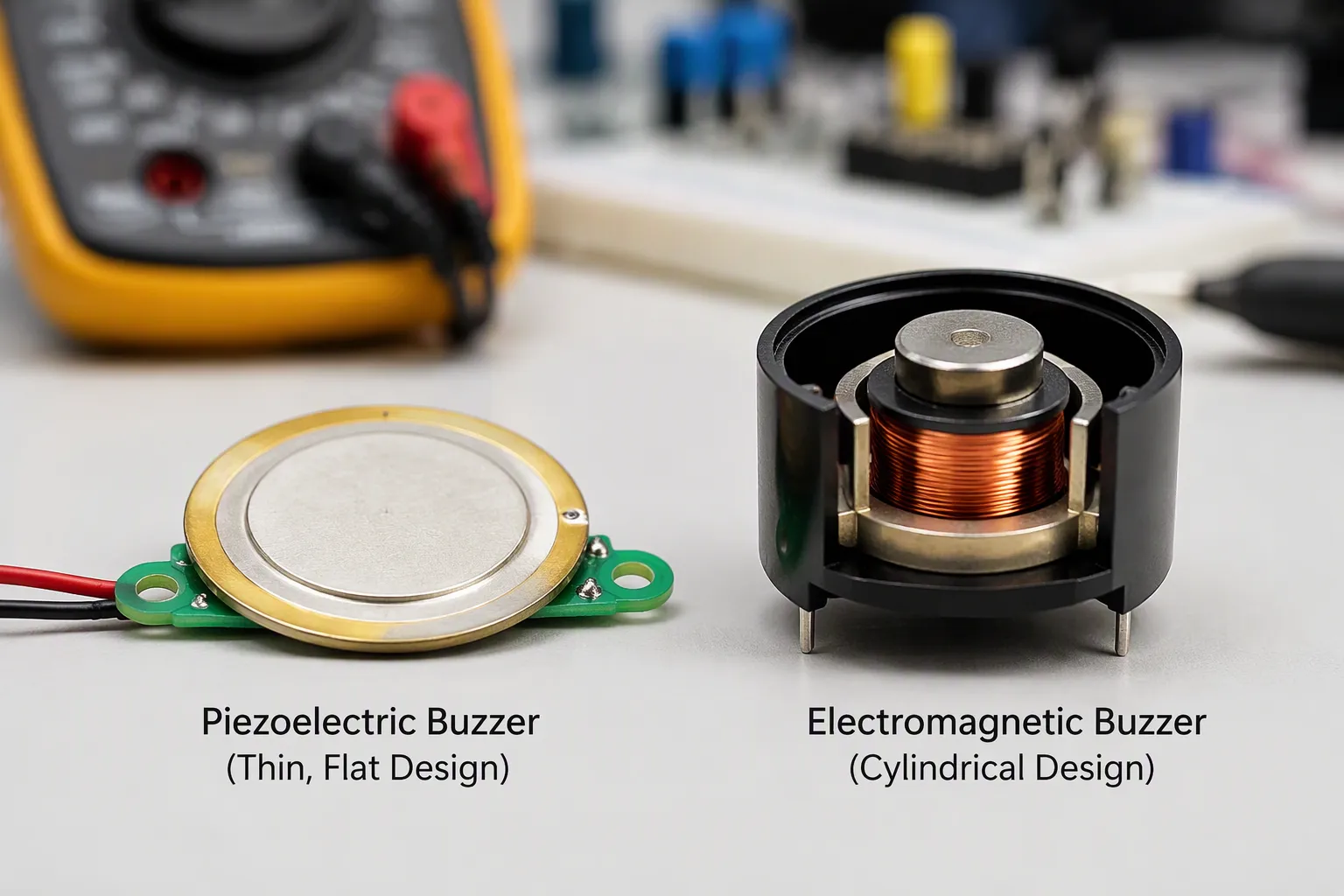
No absolute winner exists in this comparison. Selection depends entirely on application requirements. A design that favors one type may fail with the other. The core trade-off is easy to state: Piezoelectric buzzers are thin, draw little power, accept a wide voltage range, and produce low magnetic interference. Electromagnetic buzzers deliver richer sound, higher sound pressure at low voltage, and a higher current draw.
When Piezoelectric Buzzers Win
Piezoelectric buzzers suit designs that prize efficiency and flexibility. Their capacitive nature keeps steady-state current minimal. Key advantages include:
Ultra-low current draw: Typically stays below 10 mA, with SMD models consuming as little as 1–3 mA. General-purpose parts rarely exceed 30 mA even at higher frequencies.
Wide operating voltage: Spans from 3 V to 250 V, allowing one part family to serve both low-voltage battery products and higher-voltage industrial panels.
Thin profile & low EMI: Ideal where board height is tight and magnetic interference must be minimized near sensitive sensors and radios.
Individual models from HUAWHA illustrate this versatility: the KPI-1410 covers 3–16 V, the KPI-2210L covers 3–30 V, and the KPI-2610 covers 3–24 V. These traits explain why passive piezo buzzers are typically the most power-efficient choice for low-power devices, including wearables, IoT edge nodes, remote controls, and medical devices such as infusion pumps and patient monitors.
When Electromagnetic Buzzers Win
Electromagnetic buzzers win when sound quality and low-voltage output dominate. The coil-and-magnet mechanism moves a diaphragm with more acoustic body, producing a warmer, fuller tone that designers prefer for alert sounds that must be noticed.
Lower voltage operation: Typically sits between 1.5 V and 12 V, with specific industrial models reaching up to 30 V.
Richer sound profile: Magnetic buzzers offer smoother frequency response ideal for consumer electronics UI tones.
Higher current draw: Commonly 30 mA to 100 mA, which buys stronger acoustic output at low supply voltages.
This characteristic fits automotive electronics and home appliances where lower-voltage drive is preferred and a pleasant auditory experience matters. The table below summarizes the central contrast.
Parameter | Piezoelectric | Electromagnetic |
|---|---|---|
Operating voltage | 3 V to 250 V | 1.5 V to 12 V (up to 30 V) |
Current draw | Under 10 mA typical (SMD: 1–3 mA) | 30–100 mA typical |
Profile | Thin, low-profile | Taller coil assembly |
Magnetic interference | Very low | Moderate to high |
Sound character | Sharp, high-pitched | Richer, fuller tone |
HUAWHA Recommended Series |
This piezoelectric vs. electromagnetic buzzer trade-off frames every later decision. Voltage headroom, current budget, acoustic target, and mechanical space each push the choice one way. The sections that follow examine the mechanisms behind these numbers.
What Is a Piezoelectric Buzzer?
Working Principle and Structure
A piezoelectric buzzer centers on a thin ceramic disk. The disk sits on a metal substrate, and electrical contacts rest on its two faces. The assembly is edge-supported inside an enclosure. Applying a voltage across the ceramic deforms the material. This deformation flexes the disk and pushes air, which produces sound. The element behaves electrically like a capacitor. Voltage drives the motion, and steady-state current stays small. Some designs add a feedback line through a split piezo element, enabling simpler self-oscillating drive circuits.
Construction stays simple and inexpensive. A disk, two contacts, and a housing form the core of the part. This simplicity supports low cost and wide use across audio sounder applications.
Key Characteristics
Piezoelectric buzzers resonate at higher frequencies than magnetic types. Key characteristics include:
Resonant range: About 2 kHz to 6 kHz, with most standard parts peaking between 2 kHz and 4 kHz.
Sound pressure level: Reaches 85 dB to 120 dB, offering a very high ceiling for alarm applications.
Frequency response: Shows sharp peaks of extreme amplitude at resonance. Driving the part at resonance yields the greatest SPL with the least input power.
The drive relationship is another strength. Output audio power tracks input drive signal strength in a reasonably linear way. A weaker drive still produces usable sound. Piezo parts are voltage-driven and draw under 10 mA in typical operation. Maximum SPL can exceed that of magnetic buzzers, though larger footprints are needed to reach it. These traits make the piezo type a natural fit for safety alarms and smoke detectors. The piezoelectric vs. electromagnetic buzzer choice often turns on exactly this profile: high frequency, high peak output, and low current.
What Is an Electromagnetic Buzzer?
Working Principle and Structure
An electromagnetic buzzer builds sound from a coil and a magnet. A small electromagnet sits near a permanent magnet, and a thin diaphragm rests above the assembly. Current flows through the coil and creates a magnetic field. That field pulls the diaphragm toward the magnet. The current reverses, and the diaphragm springs back. This rapid motion pushes air and produces sound. The coil behaves electrically like an inductor. Current drives the motion, and the part stores energy in its magnetic field.
Coil inductance shapes the drive circuit. Electromagnetic buzzer coils typically fall within the following inductance range:
Lower bound: 1 milli-Henry (1,000 µH)
Upper bound: 100 milli-Henry (100,000 µH)
A passive magnetic buzzer or a low-resistance buzzer is essentially an electromagnetic speaker. It needs an AC drive signal at the target frequency. Do not drive it like a piezo buzzer. A piezo element is capacitive and accepts a voltage drive. A magnetic part is inductive and responds to current. Feeding a square wave voltage directly into a low-resistance coil can overload the driver.
Key Characteristics
Electromagnetic buzzers produce a smoother sound than piezo types. The frequency response curve is wider and more dynamic, without the sharp peaks of a ceramic element. Key characteristics include:
Resonant frequency: Typically 1 kHz to 3 kHz, producing fuller, warmer notes.
Sound pressure level: Moderate at 70 dB to 95 dB.
Frequency response: Smoother and wider, ideal for pleasant UI tones in consumer electronics.
Characteristic | Magnetic Buzzer | Piezo Buzzer |
|---|---|---|
Resonant frequency | 1 kHz to 3 kHz | 2 kHz to 6 kHz |
SPL | 70 dB to 95 dB | 85 dB to 120 dB |
Frequency response | Smoother, wider range | Sharp peaks at resonance |
Typical use | Pleasant UI tones, doorbells | Safety alarms, smoke detectors |
Reliability is another strength. Magnetic buzzers withstand harsh environmental conditions in both indoor and outdoor applications, which is why HUAWHA's ruggedized magnetic series is widely deployed in automotive and industrial settings. They also come in a wide range of frequency options, allowing flexibility in generating different audible tones and melodies. This piezoelectric vs. electromagnetic buzzer contrast explains why many designs pair a magnetic part with a friendly notification sound.
Active vs. Passive Buzzers
Active Buzzers Explained
An active buzzer contains its own oscillator circuit. Apply a DC voltage, and the internal circuit generates the drive signal. The buzzer produces sound at a fixed frequency. No external waveform is needed. This design simplifies the host circuit considerably. A single GPIO pin or a switched supply rail can turn the buzzer on and off.
The trade-off is flexibility. An active buzzer plays one tone at one frequency. Melodies and multi-tone alarm patterns are not possible without changing parts. Active versions exist in both piezoelectric and electromagnetic families. Choose an active part when the application needs a simple on/off alert and the tone is fixed by design.
Passive Buzzers and Drive Circuitry
A passive buzzer has no internal oscillator. It needs an external AC signal or PWM waveform to produce sound. The drive signal frequency sets the pitch. This arrangement gives full control over tone, melody, and alarm patterns. The host microcontroller generates the waveform, and the buzzer reproduces it.
Drive strength matters here. A passive piezo buzzer or any buzzer drawing more than 40 mA needs a transistor driver. A typical NPN stage uses these connections:
GPIO to a 1 kΩ base resistor, then to the transistor base
Buzzer between VCC and the transistor collector
Transistor emitter to GND
Flyback diode across the buzzer, cathode to the VCC side
A BC547 in this stage switches loads up to roughly 600 mA, well beyond the direct-drive limit of a GPIO pin. The PWM frequency from the microcontroller then controls the tone pitch.
Piezo transducers accept a simpler drive than magnetic parts. The diode across the transducer becomes unnecessary because its inductance is low. A resistor is needed instead to reset the voltage when the switch opens. That resistor dissipates power, so this simple circuit is not normally preferred. A full bridge of four switches applies twice the supply voltage peak-to-peak across the transducer, yielding roughly a 6 dB increase in sound volume.
Comparing Key Specifications
Resonant Frequency, SPL, and Frequency Response
Resonant frequency sets the pitch a buzzer produces most efficiently. Piezoelectric parts are mechanically tuned, and they are loudest at their resonant point. Standard piezo parts typically resonate between 2 kHz and 6 kHz, with most falling in the 2–4 kHz range. Driving a piezo part far from resonance causes the sound pressure to collapse. Electromagnetic buzzers sit lower, with resonant frequencies from 1 kHz to 3 kHz. That lower range produces fuller, warmer notes.
HUAWHA Model | Type | Resonant Frequency | Resources |
|---|---|---|---|
HNR-1207PA5.0 | Passive Magnetic | 4000 ± 500 Hz | |
HNR-3010 | Passive Magnetic | 3500 ± 500 Hz | |
HNR-3920 | Passive Magnetic | 3400 ± 500 Hz | |
HND-2316 | Active Magnetic | 3000 ± 500 Hz | |
HND-2495 | Active Magnetic | 3400 ± 300 Hz | |
HND-3020 | Active Magnetic | 2800 ± 500 Hz | |
BJ-3 | Active Magnetic | 2500 ± 500 Hz | |
MLT-1230 | SMD Passive Piezo | 4000 ± 300 Hz |
Featured HUAWHA Products for Your Design
To help you quickly evaluate our solutions, here is a selection of our most popular piezoelectric and electromagnetic buzzers. Click on any model to view detailed specifications, dimensions, and download datasheets.
Product Description | Technology | Voltage | SPL | Resources |
|---|---|---|---|---|
12VDC 85dB Piezo Buzzer | Piezoelectric | 12V DC | 85 dB | |
12VDC 90dB Piezo Buzzer | Piezoelectric | 12V DC | 90 dB | |
Mini 12VDC 85dB Piezo Buzzer | Piezoelectric | 12V DC | 85 dB | |
Mini 5VDC 85dB Electromagnetic Buzzer | Electromagnetic | 5V DC | 85 dB | |
3VAC 85dB Mini Electromagnetic Buzzer | Electromagnetic | 3V AC | 85 dB | |
5VDC 85dB Electromagnetic Buzzer | Electromagnetic | 5V DC | 85 dB | |
Mini 3VDC 85dB Electromagnetic Buzzer | Electromagnetic | 3V DC | 85 dB | |
3Vo-p 75dB Mini Electromagnetic Buzzer | Electromagnetic | 3V p-p | 75 dB |
Sound pressure level follows the same split. Piezo parts reach a higher ceiling, while magnetic parts deliver moderate output with a smoother, wider response curve. The piezo curve shows sharp peaks. The magnetic curve stays flatter across its band.
Current Draw and Power Consumption
Voltage range is the first contrast. Piezoelectric buzzers accept roughly 3–250 V, while magnetic buzzers typically cover about 1.5–12 V. That wide piezo span lets one part family serve battery products and industrial panels alike.
Current draw separates the two types even more sharply. Magnetic buzzers typically consume 30–100 mA. Piezo current stays significantly lower because the ceramic element behaves like a capacitor. Measured figures show how low it can go:
External NPN transistor stage with a 1 kΩ parallel resistor: 2.8 mA
Direct MCU drive with a 220 Ω series resistor: 2.4 mA
Direct MCU drive without a parallel resistor: Microamp range
Manufacturer spec example: 7 mA max at 9 V peak-to-peak, 4 kHz
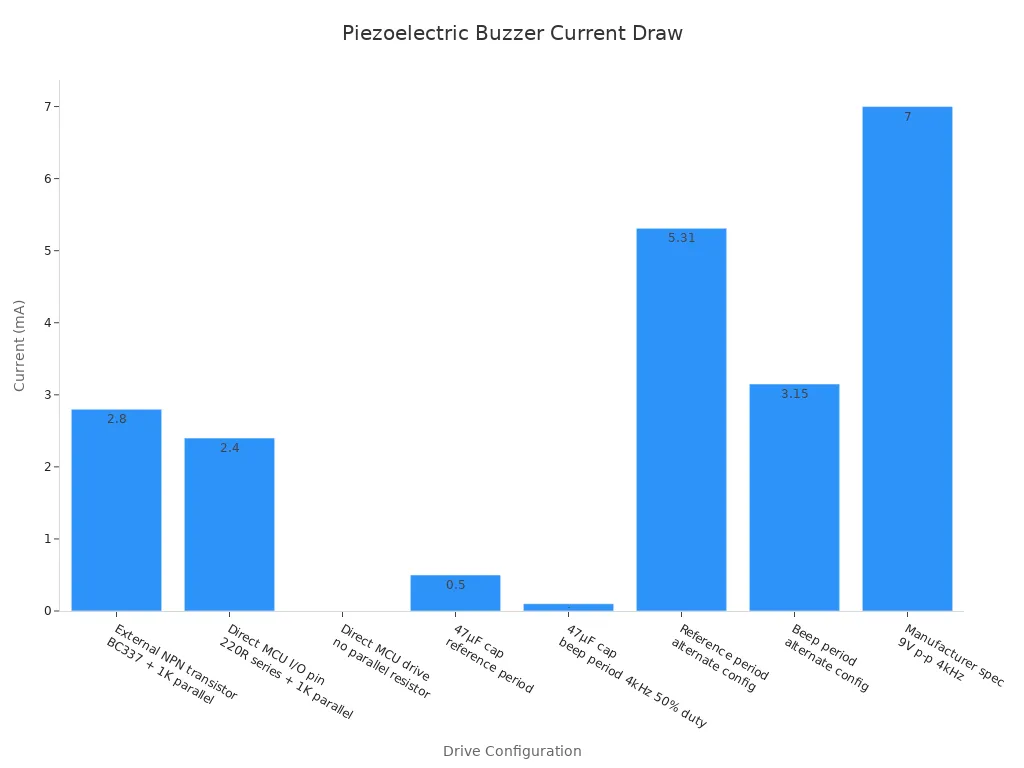
These numbers shape the power budget. A magnetic part at 30–100 mA can dominate a small battery's drain. A piezo part at a few milliamps leaves headroom for other loads.
Sound Characteristics and Applications
Tone Quality and Volume Profiles
The two families occupy different acoustic territory:
Piezoelectric parts: Concentrate energy in the high band (1000–5000 Hz). Their tone is crisp, sharp, and directional.
Electromagnetic parts: Cover a wider band (200–3000 Hz) and stay stable in the mid and low range. Their thicker, lower tone travels farther through open space.
Volume behavior follows the same split. A magnetic buzzer can emit more than 85 dB at just 1.5 V, and same-size units typically reach up to 90 dB. A piezo part needs a higher drive voltage to reach sufficient sound pressure, yet larger sizes easily reach 100 dB, and some specifications exceed 120 dB. A thin piezo element under 1 mm can still produce up to 70 dB at 20 cm. Piezo parts also run quiet electrically and last more than 10,000 hours.
Characteristic | Piezoelectric Buzzer | Electromagnetic Buzzer |
|---|---|---|
Volume profile | Lower overall; stronger at high frequencies | Louder in the low and mid band |
Frequency range | 1000–5000 Hz, crisp and directional | 200–3000 Hz, thicker and lower |
Typical use | Close-range prompts, safety alarms | Strong-penetration alarms, pleasant notifications |
Common Use Cases for Each Type
Both types serve telecommunications, home appliances, automobiles, electric bicycles, UPS systems, instrumentation, and electronic toys. The split appears in how each is deployed:
Piezo applications: Smoke alarms, security systems, medical equipment (benefiting from ISO 13485 certified manufacturing), vending machines, and compact consumer devices. Their thin profile fits tight enclosures, and low magnetic interference protects nearby sensors and radios.
Magnetic applications: Automotive reminders, parking sensors, intrusion detectors, gas detectors, printers, and office control panels. Their fuller tone carries well in alarm systems for residential and commercial buildings.
This piezoelectric vs. electromagnetic buzzer distinction guides most designs: match the tone profile and penetration needs to the job.
Choosing Between Piezoelectric and Electromagnetic Buzzers
Pros and Cons of Each Type
Each family carries a distinct set of strengths and weaknesses. Weighing them side by side clarifies the piezoelectric vs. electromagnetic buzzer decision for a given design.
Piezoelectric buzzers offer clear advantages:
Very low current draw, typically under 10 mA, with SMD models reaching 1–3 mA, which extends battery life significantly.
A wide operating range of 3 V to 250 V, covering both low-voltage and high-voltage designs.
High sound pressure level, from 85 dB to 120 dB, which suits alarms and smoke detectors.
A compact, solid-state build that resists shock and moisture.
Their drawbacks are equally clear. They need a higher voltage to reach maximum output. The tone can sound harsh or piercing to some users. Low-frequency response is limited, and the frequency band is narrower than that of magnetic parts.
Electromagnetic buzzers bring their own trade-offs. They deliver durability and loudness, and they perform well where a steady, pleasant tone is required. They also suit cost-sensitive projects. Their weaknesses are power consumption and size. The coil assembly draws more current and takes up more room than a ceramic disk. Construction is more complex, so unit cost runs higher than a simple piezo part in some configurations, though they remain very competitive at high volumes.
Comparison Table and Decision Checklist
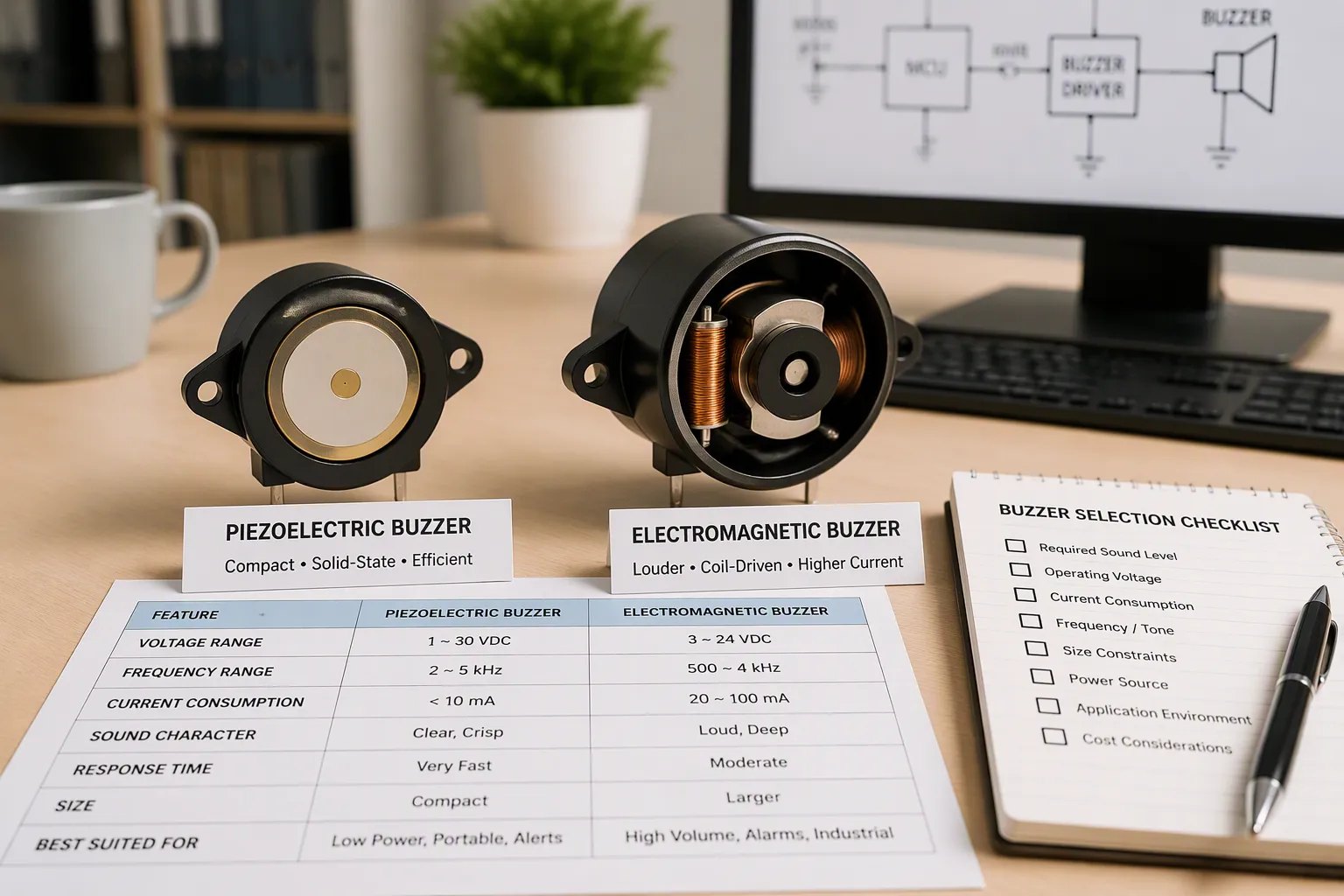
A structured comparison puts the key specifications in one view. The table below draws on the figures established earlier in this article.
Specification | Piezoelectric Buzzer | Electromagnetic Buzzer |
|---|---|---|
Operating voltage | 3 V to 250 V | 1.5 V to 12 V (up to 30 V) |
Resonant frequency | 2 to 6 kHz | 1 to 3 kHz |
Sound pressure level | 85 to 120 dB | 70 to 95 dB |
Current consumption | Under 10 mA (SMD: 1–3 mA) | 30–100 mA |
Typical size | 12 mm to 50 mm | 7 mm to 25 mm |
Best for | Low-power alarms, medical devices, meters, industrial panels | Low-voltage alarms, doorbells, timers, automotive electronics |
Cost deserves a place in the checklist. Piezoelectric units generally run about $0.20 to $0.65 per unit, while electromagnetic parts sit at roughly $0.15 to $0.45. The magnetic type is often the cost-effective pick for high-volume runs. The piezo type earns its price through advanced features, miniaturization, and superior reliability in demanding applications.
Work through these questions in order:
What voltage does your supply provide? A low rail (under 12 V) favors the magnetic type; a wide or high rail favors piezo.
What is your current budget? Battery-powered designs usually point to piezo.
What sound do you need? A piercing alarm suits piezo; a steady, fuller tone suits magnetic.
How much space do you have? Check the size ranges above against your enclosure constraints.
What is your unit volume and target cost? Compare both price bands against your production quantity.
Answer these five questions, and the right family usually becomes obvious.
Voltage Considerations
Operating Voltage Ranges and Drive Requirements
The two buzzer families sit in very different voltage territory. Piezoelectric parts accept a wide span, with typical operating ranges from 3 V to 250 V. Their capacitive nature means they are voltage-driven, not current-driven. Current draw stays under 10 mA in most cases, and specialized low-power designs draw as little as 1–3 mA. A full bridge drive circuit can raise the peak-to-peak voltage across the element and boost output significantly.
Electromagnetic buzzers work in low-voltage systems, typically 1.5 V to 12 V. Their voice coil draws 30 mA to over 100 mA. Drive requirements also depend on configuration. A self-drive indicator unit needs only a DC voltage, and versions exist for 3–28 Vdc, 110 Vac, or 230 Vac. A non-self-drive transducer needs an external excitation waveform, often 1–60 Vp-p, switched by a BJT or FET with a diode to clamp flyback voltage.
Parameter | Piezoelectric | Electromagnetic |
|---|---|---|
Operating voltage | 3–250 V | 1.5–12 V (up to 30 V) |
Current draw | Under 10 mA (SMD: 1–3 mA) | 30 mA to over 100 mA |
Drive type | Voltage-driven | Current-driven |
Matching Buzzers to Your Power Supply
A matching nominal voltage alone is not enough. Compare the buzzer's required voltage and current against the supply's continuous and peak ratings. Check off-state leakage, short-circuit protection, and whether the output is meant to switch that load type. Observe polarity during connection to prevent damage, and add resistors where needed to limit current.
Verification takes a few simple steps. Confirm the supply falls inside the buzzer's range, commonly 3 V to 12 V. Measure the voltage at the terminals with a multimeter; a 5 V buzzer should read roughly 4.8 V to 5.2 V. A reading near 2.5 V means the buzzer may stay silent or sound weak, so adjust or replace the source. Battery-powered designs deserve extra care, since a drained cell delivers too little voltage for reliable operation.
The piezoelectric vs. electromagnetic buzzer decision comes down to a clear trade-off. Piezoelectric parts offer low current draw, a wide voltage range, a thin profile, and high-frequency tones. Electromagnetic parts deliver richer sound, lower frequency output, and higher SPL at low voltage. Match the type to your voltage, current budget, sound requirements, and environment. That framework settles most designs quickly.
For application-specific guidance, consult an experienced supplier. HUAWHA Electronics has manufactured premium buzzers since 2007. The company holds CE, RoHS, ISO 9001:2015, ISO 13485:2016 (medical-grade quality system), and FDA registrations, providing reliable ODM and OEM services globally. Their engineering team can help you select the right buzzer with confidence.
Need Help Choosing the Right Buzzer for Your Project?
Our engineering team at HUAWHA Electronics is ready to provide custom acoustic solutions, free samples, 3D models for your PCB design, and detailed datasheets for any model mentioned in this article.
With nearly 20 years of manufacturing experience and ISO 13485 certification for medical applications, we ensure every buzzer meets your exact specifications.

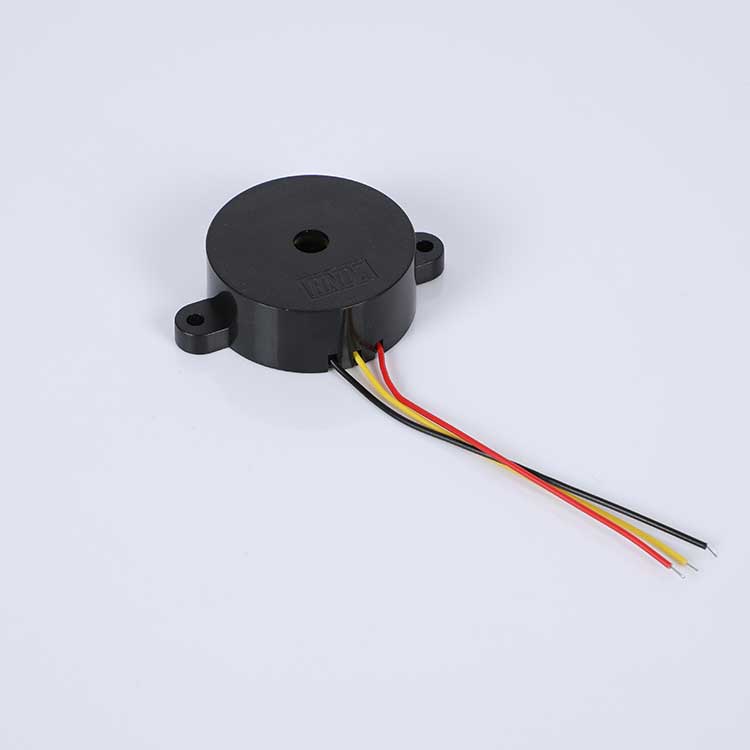

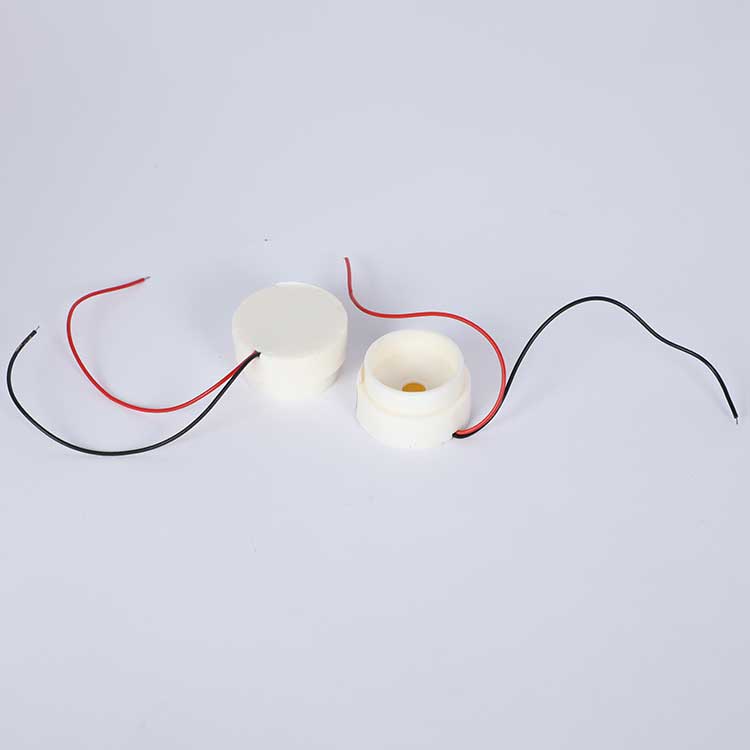

Responsible for manu-facturing and R & D buzzer series of products, products mainly SMD buzzer, electromagnetic buzzer, piezoelectric buzzer.


Site Navigation
HomeAbout UsProductsQuality AssuranceNewsContact Us
Product Categories
Smd BuzzerPin BuzzerLead BuzzerElectromagnetic BuzzerPiezo BuzzerActive BuzzerPassive BuzzerAlarm
Contact Us
E-mail: doris@jshnbuzzer.com
Mobile: 0086-13809014205
WhatsApp: +86-13809014205
Add: Chenbao Industry Park, Xinghua City, Taizhou, Jiangsu China