
 doris@jshnbuzzer.com
The Complete Guide to Piezoelectric Buzzers: What They Are and How They Work
 Feb 25, 2026|
 View:1502
In the world of electronic components, few devices are as universally recognized yet little understood as the piezo electric buzzer. That persistent beep from your microwave when your food is ready, the reassuring click of your car's turn signal, or the urgent alarm from a medical device—chances are, a piezo electric buzzer is the small but mighty component alerting you.
At HUAWHA Electronics, we've spent over 15 years mastering the science of sound. As a leading buzzer manufacturer in China, we specialize in creating high-quality piezoelectric, electromagnetic, and SMD buzzers that power devices in over 100 countries. But what exactly is this component, and why is it so essential to modern electronics? This guide will decode the technology, explore its applications, and help you understand everything you need to know about the piezo electric buzzer.
Key Takeaways
| Takeaway | Description |
|---|---|
| Core Technology | A piezo electric buzzer uses the reverse piezoelectric effect, where a ceramic disc deforms when voltage is applied, creating sound. |
| High Efficiency | They are voltage-driven devices that consume very low current (typically<30mA), making them ideal for battery-powered devices. |
| Exceptional Loudness | They generate high Sound Pressure Levels (SPL), often reaching over 100dB, ensuring alerts are heard even in noisy environments. |
| Wide Voltage Range | Piezo electric buzzer models are available to support a broad spectrum of power sources, from 3V for wearables to 24V for industrial machinery. |
| Two Main Types | They come as indicators (with built-in drive circuitry for a fixed tone) and transducers (which require an external circuit to generate a frequency). |
| Durability | Their solid-state construction means they are highly reliable, lightweight, and resistant to harsh conditions like temperature extremes and voltage fluctuations. |
What is a Piezo Electric Buzzer? Understanding the "Beep"
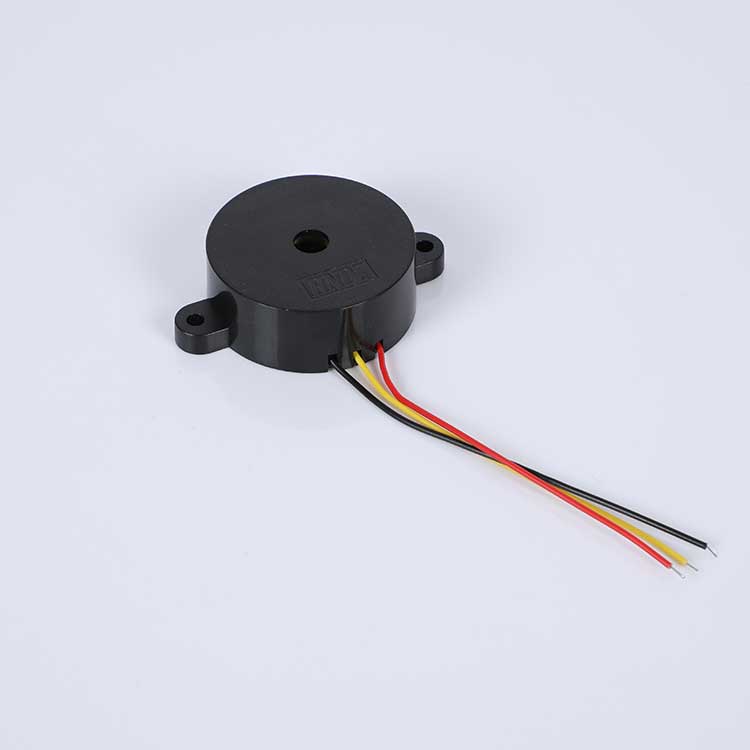
At its simplest, a piezo electric buzzer is an audio signaling device that produces sound. Unlike a traditional speaker that uses a magnetic coil and cone, it leverages a unique property of specific materials called the piezoelectric effect.
The Science of Sound: The Piezoelectric Effect
The magic begins with piezoelectric ceramic, a man-made material. When an electric field is applied to this material, it physically stretches or shrinks. This is known as the reverse piezoelectric effect.
In a standard piezo electric buzzer, a thin disc of this piezoelectric ceramic is bonded to a metal plate (usually brass). When an oscillating (alternating) electrical signal is applied:
Deformation: The ceramic disc expands and contracts rapidly.
Vibration: This causes the bonded metal plate to bend and vibrate in both directions.
Sound Wave: These high-speed vibrations displace the air around them, creating sound waves that our ears perceive as a tone or beep.
This entire mechanism is typically housed in a protective plastic case, which also helps to amplify the sound pressure.
Piezo Electric Buzzer vs. Magnetic Buzzers: A Quick Comparison
| Feature | Piezo Electric Buzzer | Magnetic Buzzer |
|---|---|---|
| Operating Principle | Piezoelectric effect (ceramic deformation) | Electromagnetism (coil and magnetic field) |
| Drive Method | Voltage-driven | Current-driven |
| Typical Voltage | 3V - 220V+ (wide range) | 1.5V - 12V (narrow range) |
| Current Consumption | Very Low (< 30mA) | Higher (20mA - 110mA+) |
| Sound Pressure Level | High (can exceed 100dB) | Moderate |
| Resonant Frequency | Higher (2 kHz - 6 kHz+) | Lower (1 kHz - 3 kHz) |
| Construction | Simple, robust, no coil | More complex, includes a coil and ferromagnetic disk |
| Best For | Alarms, high-pitch alerts, battery-powered devices | Keyboards, phones, lower-frequency tones |
Key Specifications: How to Choose the Right Piezo Electric Buzzer
Selecting the correct piezo electric buzzer for your application requires understanding a few critical specifications. At HUAWHA Electronics, we design our buzzers to meet precise standards, ensuring seamless integration into your project.
1. Voltage Rating
Piezo electric buzzer performance is directly linked to voltage. A higher driving voltage generally results in a louder sound. We offer a comprehensive range to match your power supply:
3V & 5V Piezo Buzzers: Perfect for battery-operated and portable devices like glucose meters, thermometers, and IoT wearables.
12V Piezo Buzzers: The standard for automotive applications, industrial controls, and alarm systems.
24V Piezo Buzzers: Designed for heavy machinery and high-power industrial equipment where reliability is paramount.
2. Current Consumption
One of the biggest advantages of a piezo electric buzzer is its low current draw. While magnetic buzzers can consume over 100mA, a piezo element typically requires less than 30mA, and often as low as 3-7mA. This efficiency is critical for extending the battery life of portable devices.
3. Sound Pressure Level (SPL)
Measured in decibels (dB), SPL indicates how loud the buzzer is. A difference of just 3dB represents a significant change in loudness. Our piezo electric buzzer models are engineered to deliver high SPL, ensuring your device's alerts are unmistakable.
4. Resonant Frequency
A piezo electric buzzer operates most efficiently and produces the loudest sound when driven at its resonant frequency. This is typically between 2 kHz and 6 kHz, the range to which the human ear is most sensitive.
5. Size and Mounting Style
Our piezoelectric buzzers are available in sizes as small as 4mm to 9mm for space-constrained devices. We offer various mounting options, including through-hole pins and wire leads, to suit your PCB design.
Indicators vs. Transducers: Active or Passive?
When browsing our selection of piezo electric buzzer products, you'll encounter two main categories. Understanding the difference is crucial for your circuit design.
Piezo Electric Indicator (Active Buzzer)
What it is: An indicator has a built-in oscillating circuit. When you apply a DC voltage, it generates its own AC signal to drive the piezo element.
Advantages: Incredibly easy to use. Just connect it to a power source (like a battery), and it will produce sound. It's a "plug-and-play" solution for simple alerts.
Best for: Applications where you need a single, fixed tone without complex programming, such as a simple power-on beep or a low-fuel warning.
Piezo Electric Transducer (Passive Buzzer)
What it is: A transducer contains only the piezo element itself. It requires an external circuit, like a microcontroller, to generate a square wave signal to drive it.
Advantages: Offers maximum flexibility. By changing the frequency of the input signal, you can create different tones, melodies, or even siren-like sounds.
Best for: Projects where you need varied sounds, such as multi-tone alarms, musical notifications, or feedback for user input.
Common Applications of Piezo Electric Buzzers
The versatility of the piezo electric buzzer makes it a staple across countless industries. At HUAWHA Electronics, our components are found in applications ranging from simple household items to complex medical devices.
Home Appliances: Microwaves, ovens, washing machines, and coffee makers use buzzers for timer alerts and cycle completions.
Automotive: Cars and electric bicycles utilize 12V piezo electric buzzer models for seatbelt reminders, turn signal indicators, and warning alerts.
Medical Devices: In critical care equipment like blood glucose meters and clinical thermometers, the clear, reliable sound of a piezo electric buzzer provides essential feedback to users.
Security Systems: Alarm systems, smoke detectors, and carbon monoxide sensors rely on high-decibel piezo buzzers to warn occupants of danger.
Industrial Automation: From UPS systems to heavy machinery, these buzzers signal operational status, faults, or required maintenance in noisy factory environments.
Why Choose HUAWHA Electronics for Your Piezo Electric Buzzer?
As a professional buzzers manufacturer with over 15 years of experience, HUAWHA Electronics stands behind every product we ship. Our commitment to quality and innovation ensures you receive a piezo electric buzzer that performs flawlessly.
Certified Quality: Our manufacturing processes are ISO 9001:2015 and ISO 13485:2016 certified, and our products carry CE and RoHS approvals.
Rigorous Testing: Each piezo electric buzzer undergoes extensive testing to ensure reliability across temperature extremes and voltage fluctuations.
Global Reach: Trusted by over 600 cooperative customers in more than 100 countries, we are the supplier of choice for companies seeking dependable acoustic components.
Comprehensive Support: From sample service to technical support, our team is dedicated to helping you find the perfect piezo electric buzzer for your needs.
Installation and Handling Best Practices
To ensure the longevity and performance of your piezo electric buzzer, proper handling during assembly is key. Here are some important guidelines based on industry best practices:
Avoid High-Pressure Air: Never blow high-pressure air directly into the sound-emitting hole of the buzzer. This can crack the internal diaphragm, leading to low or no sound output.
Minimize Stress After Soldering: Once the buzzer is soldered onto the PCB, avoid applying external pressure or stress to its case. Excessive force can cause the case to come off or damage the internal connections.
Ensure Proper Mounting: Make sure the buzzer is seated flat against the PCB before soldering to prevent it from being tilted, which could strain the terminals.
Frequently Asked Questions About Piezo Electric Buzzers
Q: What is the main difference between a piezo buzzer and a magnetic buzzer?
A: The fundamental difference lies in how they produce sound. A piezo electric buzzer uses a piezoelectric ceramic disc that vibrates when voltage is applied. A magnetic buzzer uses an electromagnet to vibrate a ferromagnetic disk. Piezo buzzers are voltage-driven with low current draw, while magnetic buzzers are current-driven and consume more power.
Q:Can I use a 12V piezo buzzer on a 5V system?
A: It is not recommended. A piezo electric buzzer is designed for a specific voltage range. Using a 12V buzzer on a 5V system will result in a much lower sound output (SPL). For optimal performance, always select a buzzer with a voltage rating that matches your power supply. HUAWHA offers a full range of 3V, 5V, 12V, and 24V options.
Q:Why is my piezo electric buzzer not loud enough?
A: Several factors can affect loudness. First, ensure you are driving it at its resonant frequency, as this produces the maximum SPL. Second, check that the driving voltage is sufficient. For a transducer, increasing the peak-to-peak voltage of your drive signal will increase the volume. Finally, verify that the sound-emitting hole is not obstructed.
Q:What does "passive" and "active" mean for a piezo buzzer?
A: An active buzzer (indicator) has a built-in oscillator and produces sound when DC power is applied. It's simple but has a fixed tone. A passive buzzer (transducer) requires an AC signal or square wave from a microcontroller to make sound, allowing you to create different tones and melodies.
Q:What are common problems after soldering a piezo buzzer?
A: The most common issues arise from physical stress. Applying high-pressure air to clean the board after soldering can crack the piezo element. Similarly, pressing down on the buzzer or assembling it with stress on the case can muffle the sound or detach the casing.
Q:Are HUAWHA piezo buzzers RoHS compliant?
A: Yes, all piezo electric buzzer models from HUAWHA Electronics are manufactured with RoHS-approved materials and processes, ensuring they meet global environmental and safety standards.
Conclusion
The piezo electric buzzer is a testament to how a simple, elegant physical principle can create an indispensable device. From its low power consumption and high efficiency to its remarkable durability and loud, clear output, it remains the go-to choice for audible indicators across the electronics world.
Whether you are designing the next generation of medical devices, automotive systems, or smart home appliances, selecting the right piezo electric buzzer is critical. With decades of experience, a robust quality management system, and a customer-centric approach, HUAWHA Electronics is your ideal partner for all things acoustic.
Ready to find the perfect piezo electric buzzer for your next project? Contact our team today for expert advice, samples, and competitive pricing.