

 doris@jshnbuzzer.com
Where Are Buzzers Used? Applications Across Major Industries
 Oct 13, 2026|
 View:3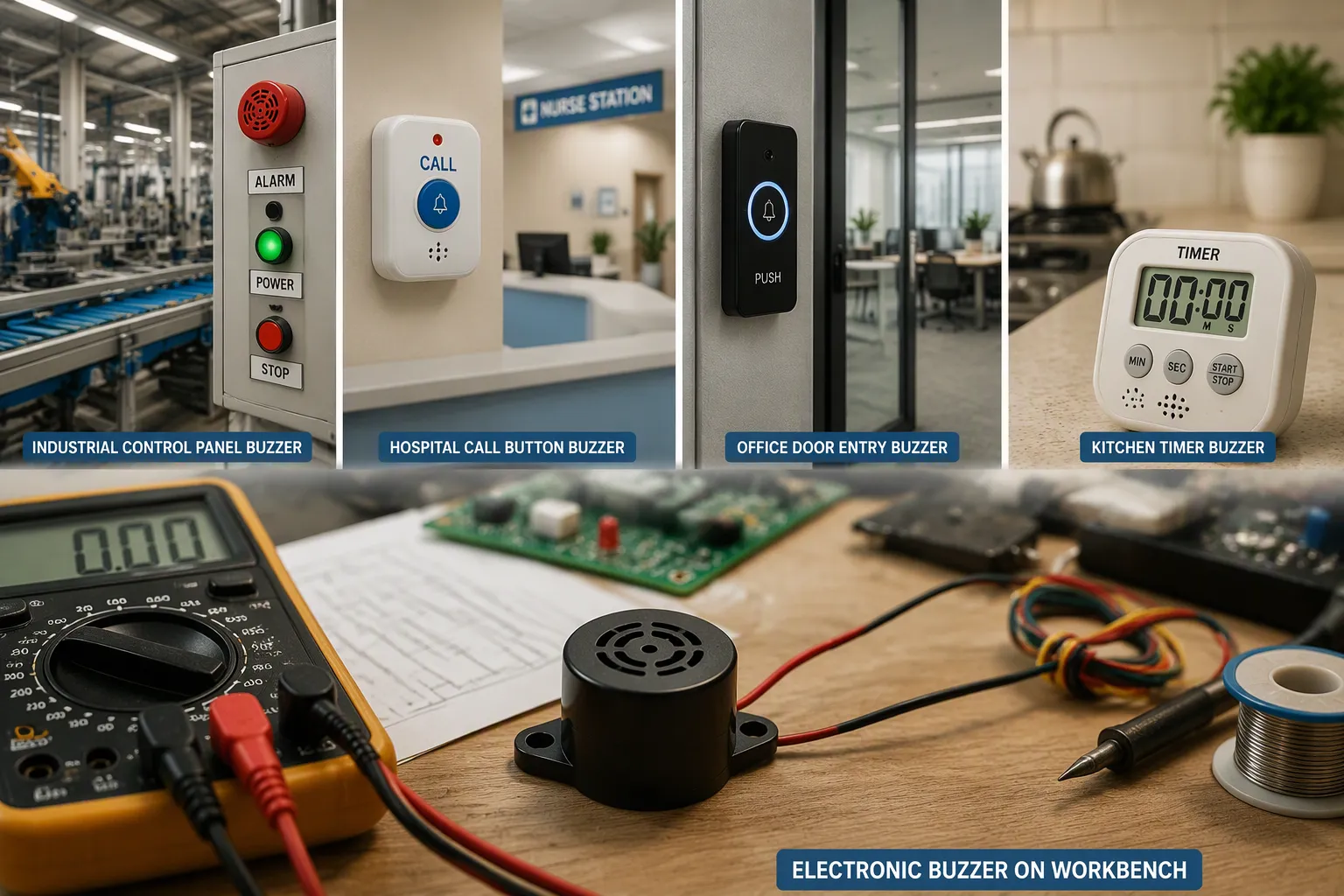
Where are buzzers used? These small electronic signaling devices appear in automotive, healthcare, consumer electronics, industrial, and security industries. A car seatbelt chime reminds you to buckle up. A hospital infusion pump beeps when the drip finishes. A microwave signals when your food is ready. A factory control panel sounds an alert when a machine overheats. A home security system buzzes when a door opens. The global buzzer market was valued at USD 805.80 million in 2023 and is projected to reach USD 1,246.06 million by 2032, growing at a 5.6% CAGR. Automotive electronics is the fastest-growing segment at 6.51% CAGR. These applications of buzzers show how essential they are for safety and communication across various industries and daily life.
Key Takeaways
Buzzers keep you safe in cars and hospitals with important sounds.
Everyday devices like microwaves and watches use buzzers to alert you.
Factories rely on buzzers to warn workers about machine problems.
Security systems use buzzers to tell you when a door opens or an alarm triggers.
Buzzers come in different types and specifications to fit different needs.
Automotive and Healthcare Applications of Buzzers
Automotive Warning and Alert Systems
Vehicles rely on buzzers for critical safety notifications. Seatbelt reminders use audible signals to prompt drivers and passengers. In the United States, FMVSS No. 208 requires an audible warning lasting 4 to 8 seconds for the driver's seat. The European Union's UNECE Regulation No. 16 mandates audible signals for front seats lasting at least 30 seconds. Reverse alert systems produce sound levels between 97 dB and 112 dB at approximately 1000 Hz. Dashboard warnings for low fuel, open doors, or engine issues also depend on these devices. Automotive alert systems demand reliability under vibration and temperature changes. Piezo buzzers draw under 30mA and operate across 3V to 250V, while electromagnetic types consume 20mA to over 100mA at 1.5V to 30V. HUAWHA Electronics offers buzzers from 3V to 24V with outputs from 75dB to 110dB, suitable for automotive uses.
Medical Device Alarms and Monitoring
Healthcare equipment depends on buzzers for patient safety and operational alerts. Infusion pumps signal when drips finish or occlusions occur. Patient monitors emit tones for irregular heart rhythms or oxygen drops. Diagnostic equipment uses audible alarms to indicate completed tests or error states. The IEC 60601-1-8 standard governs medical alarm systems, specifying frequencies from 150 Hz to 1,000 Hz and prioritizing alarms as low, medium, or high. This standard applies to alarm systems in medical electrical equipment and systems, including patient monitors, ventilators, and infusion pumps. Piezo and electromagnetic buzzers suit healthcare settings because of low power draw and consistent performance. HUAWHA holds ISO 13485:2016 certification and FDA registration, supporting use in medical manufacturing. Their buzzers deliver 75dB to 110dB output, matching close-proximity wearables and clinical devices alike.
Consumer Electronics and Everyday Buzzer Uses
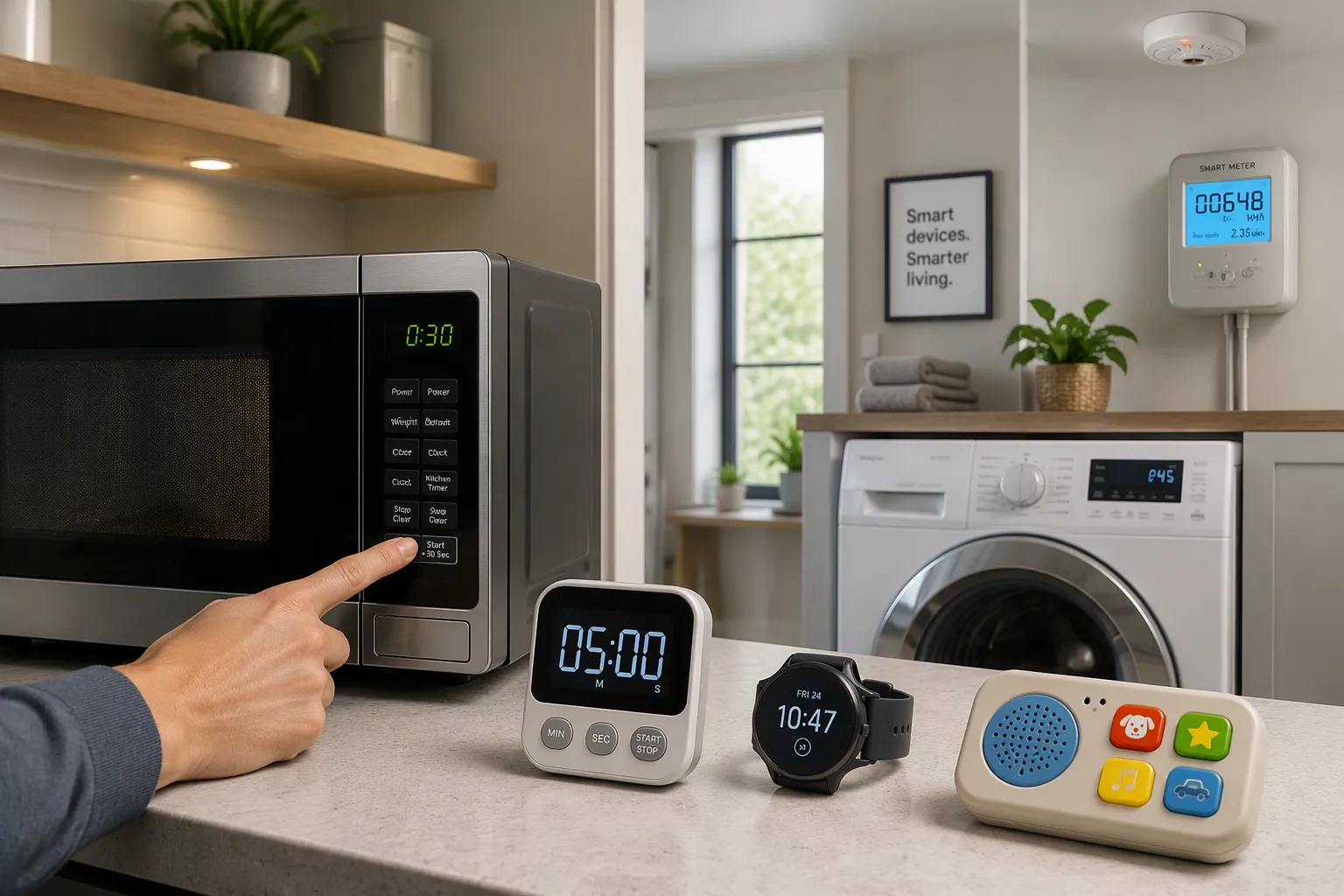
Beyond the car and hospital, where are buzzers used? They appear in microwaves, washing machines, watches, toys, timers, and smart meters. A microwave uses a piezo buzzer to signal that food is ready. A washing machine uses an electromagnetic buzzer to announce cycle completion.
Home Appliances and Personal Devices
Piezoelectric buzzers deliver high sound output from ultra-low current, making them ideal for portable gear. They work in timers, smoke detectors, games, telephones, watches, and vehicle warning devices. Home appliances rely on audible signaling for completion and error states.
Type | Typical SPL Range (dB) |
|---|---|
Magnetic | 70–85 |
Piezoelectric | 70–100+ |
Piezoelectric buzzers often reach over 100 dB, ensuring alerts are heard even in noisy environments.
Surface-mount device piezo buzzers fit phones, tablets, laptops, and smartwatches. Compact SMD and mini alarm buzzers give engineers a small, loud option. Their size lets a design team place a buzzer on a crowded PCB. For home appliances, a buzzer must handle heat, vibration, and long duty cycles. Piezo types suit these conditions because they have no moving contacts.
Toys, Timers, and Smart Meters
Electronic toys use piezo sounders for melodies and prompts. Piezo buzzers commonly produce a high-frequency output that penetrates ambient noise effectively, and operate from 3V to 24V. The broader acoustic components market was valued at USD 2.68 billion in 2023 and is projected to reach USD 5.37 billion by 2032, growing at a 7.2% CAGR.
Smart meters embed buzzers to announce tampering, low credit, or threshold breaches. Utilities value their long service life and the ability to pierce ambient noise at low energy. Across the buzzer market, the fastest-growing application segment is automotive electronics.
A timer buzzer in a kitchen signals completion; a meter buzzer can prevent unauthorized access. This buzzer use shows how a simple signaling component supports utility modernization. In consumer electronics manufacturing, buzzers improve user notifications and safety. Manufacturing tolerances keep resonance frequencies consistent. Whether a toy uses a 5V pin type or a meter uses a low-profile SMD type, the right part adds function without bulk.
Industrial Applications of Buzzers in Equipment and Control
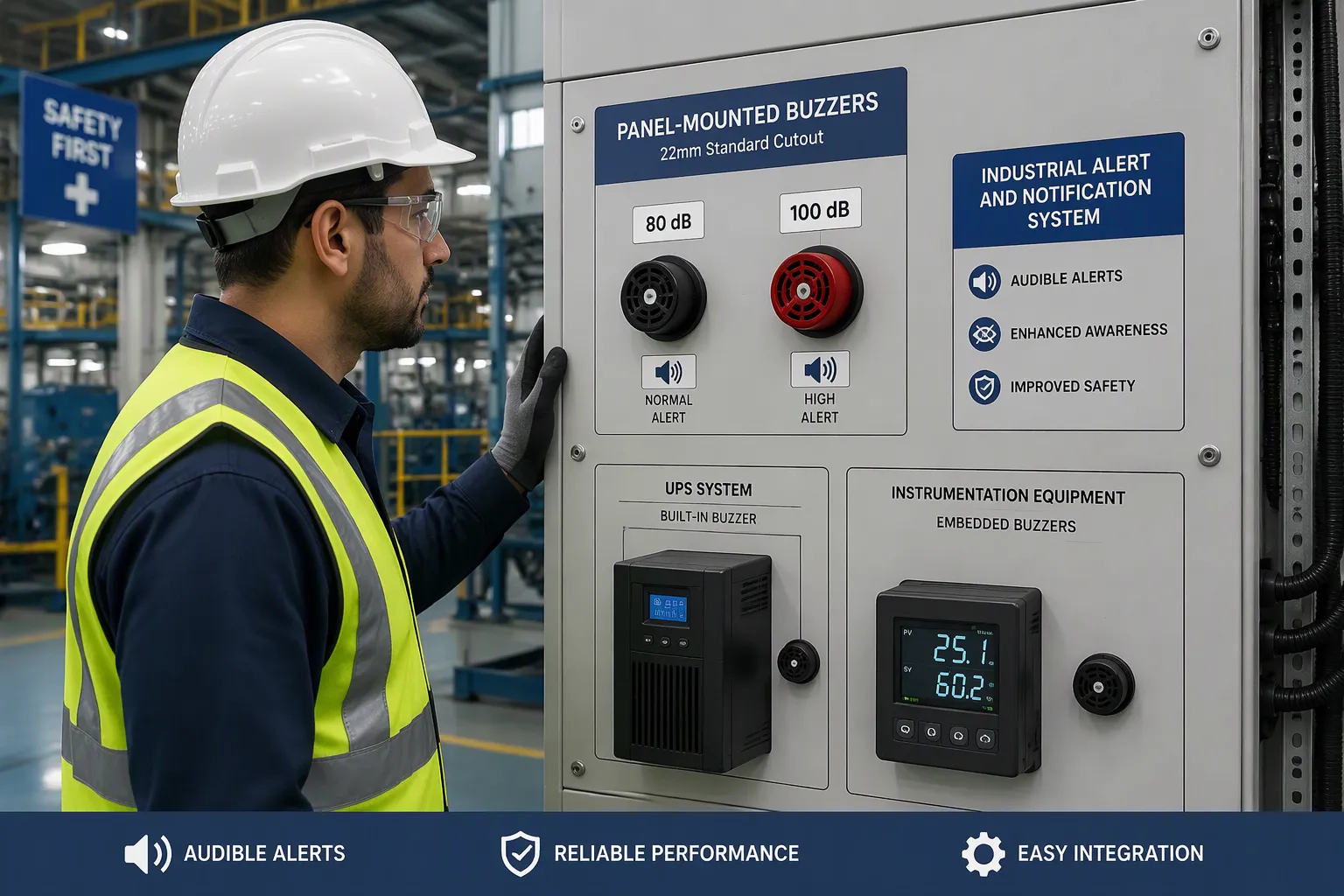
In industrial settings, the question "where are buzzers used?" points to machinery and control systems. Factory floors use audible signaling. Buzzers turn process changes and faults into clear sound.
Machinery Alerts and Control Panels
Control panels and automated manufacturing equipment carry many buzzer models. They provide a warning for machine faults, jams, or safety issues. They also signal process stage changes. High-noise production floors need loud devices. Many panel-mounted buzzers use standard panel cutouts. Some produce 75 dB at 10cm. Others reach 110 dB in the 24VDC industrial model.
Series | Sound Output | Voltage |
|---|---|---|
Piezo buzzers | Often over 100 dB at resonant peak | 3V to 250V |
70–85 dB at 10cm | 1.5V to 30V | |
HUAWHA 24VDC Mini Alarm | 110 dB | 24 VDC |
The chart below shows which equipment categories cite panel-mounted buzzers in industrial applications.
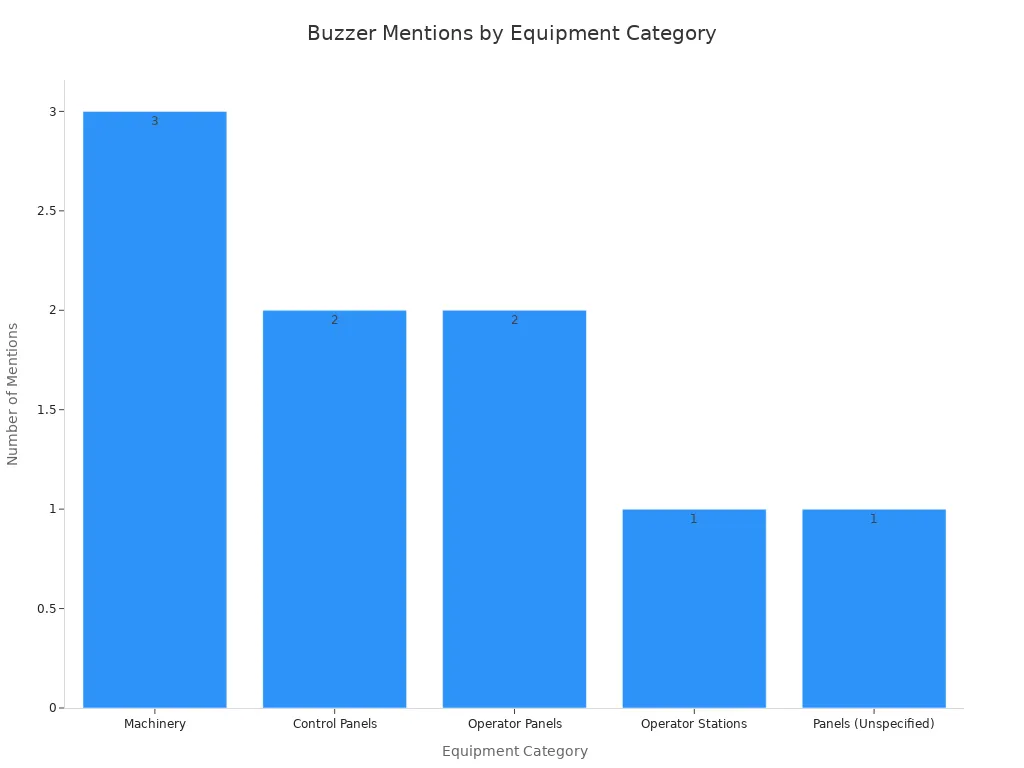
Control panels appear at the top. A machining cell requires a louder buzzer. These data help buyers match a buzzer to a manufacturing bay. As industrial automation evolves, panels integrate buzzers with visual indicators. Operators receive both visual alerts and audible alerts. An industrial buzzer must match the noise level of its surroundings.
UPS Systems and Instrumentation
Industrial automation depends on more than control panels. Uninterruptible power supplies use buzzers to announce mains failure. Instrumentation and telecommunications equipment embed compact buzzers. They deliver notifications without pulling focus. A 24V magnetic buzzer plugs into process automation power. It sounds a piercing alarm across a factory floor.
Piezo buzzers suit long duty cycles. They draw ultra-low current and produce high-frequency output that penetrates ambient noise effectively. Magnetic buzzers draw more current but operate at lower voltages, between 1.5V and 30V. Designers select them for multi-tone signaling. HUAWHA Electronics 24VDC 110dB mini alarms provide extra reach.
Manufacturing requirements shape part selection. Every buzzer must survive vibration and heat; a cabinet buzzer may need environmental protection. This practical approach makes buzzers essential to industrial automation. Manufacturing plants use them in discrete manufacturing, food manufacturing, automotive manufacturing, and electronics manufacturing. No matter the enclosure, the goal remains clear safety signaling. As industrial automation grows, these devices remain a dependable backup.
Security Systems and Alarm Buzzer Applications
Security systems depend on buzzers for intrusion detection and emergency notification. A home alarm buzzer sounds when a door opens without authorization. A business security system triggers alerts upon unauthorized access. These devices form the audible backbone of modern protection.
Home and Business Alarm Systems
The demand for security and alarm applications reflects strong market growth. Homeowners rely on these devices for break-in notifications, while businesses connect high-decibel buzzers to security systems for unauthorized access alerts.
Designers choose between active and passive drive modes. Active buzzers contain an internal oscillator and produce sound from a DC voltage. They suit simple alarm indication with minimal control circuitry. Passive buzzers need an external square wave or AC signal. They allow flexible alarm tones and siren patterns. Passive types are generally cheaper and often smaller. Active types are easier to drive directly from DC power. This choice shapes alarm design across residential and commercial properties.
Warning Devices and Safety Alerts
Buzzers serve beyond security alarms in critical safety signaling roles. Industrial warning systems rely on them where extreme durability matters. For instance, noise level alarms monitor hazardous environments at construction sites and manufacturing plants, alerting workers immediately when safe hearing limits are exceeded.
Emergency alarm system requirements govern these warning devices. The alarm must warn for necessary emergency action or safe escape. It must be perceivable above ambient noise by all employees. Audible or visual alerts must reach everyone in the facility. Approved devices include audible and visual alerting appliances. Non-supervised systems require periodic testing. Manually activated alarms must be unobstructed and readily accessible. These rules ensure warning signals protect workers across industrial environments.
Buzzers are everywhere. They appear in automotive systems, healthcare devices, consumer electronics, industrial equipment, and security alarms. Each industry relies on these components for clear signaling and safety.
The range of options is remarkable. Tiny SMD units fit portable electronics. High-output alarms serve loud factory floors. This variety supports diverse manufacturing needs across the globe.
Next time a microwave beeps or a car chime sounds, take notice. That small buzzer plays a vital role in daily communication and protection. These devices keep people informed and safe in countless ways.
FAQ
What is an active buzzer?
An active buzzer has an internal oscillator. A passive buzzer needs an external square wave. Passive types allow custom alarm tones. Reliable components are critical for medical and automotive applications.
Which industries depend on a buzzer?
Automotive systems use a buzzer for seatbelt alerts. Healthcare devices use a buzzer for infusion pump alarms. Consumer electronics and security systems also use audible signals. Industrial manufacturing plants select highly durable models.
What voltage and sound output should a buzzer provide?
Standard buzzer models operate from 3V to 24V. Sound output ranges from 75dB to 110dB. HUAWHA supplies these options. Engineers match a buzzer to the noise level. Manufacturing floors need loud alarms.
Need a Custom Buzzer Solution?
Contact HUAWHA Electronics today to discuss your specific project requirements with our engineering team.
Contact Us for a Quote