
 doris@jshnbuzzer.com
Piezo vs. Magnetic Buzzers: Why SMD Piezo Leads in Compact Designs
 May 19, 2026|
 View:440
Choosing the right buzzer for your design is more than a component decision—it shapes your power budget, PCB layout, and manufacturing flow. Piezo buzzers and magnetic buzzers operate on entirely different principles, and understanding these differences helps you reduce BOM cost, save PCB space, and improve reliability. Jiangsu HUAWHA Electronics Co., Ltd. provides a comprehensive portfolio of SMD piezo buzzers engineered precisely for these compact, low-power applications.

Key Takeaways
SMD piezo buzzers consume less than 1 mA, enabling direct GPIO drive and eliminating external transistors, diodes, and bulk capacitors.
Piezo buzzers with widths as low as 4 mm and heights under 3 mm save over 50% PCB space compared to equivalent magnetic buzzers.
Solid-state construction with no moving coils delivers higher field reliability and consistent SPL for regulatory compliance.
Operating Principles: Two Different Physics
How Piezo Buzzers Work
A piezo buzzer uses the reverse piezoelectric effect: a ceramic disc bonded to a metal plate deforms under an alternating electric field, producing sound. The element behaves as a capacitive load—typically 10 to 30 nF—and requires only a square wave voltage to operate. No DC current flows through the device. This capacitive nature means you only charge and discharge a small capacitance, with negligible power loss when driven correctly.
Key Insight: The piezo's capacitive drive consumes ~1–3 mW, while a magnetic buzzer draws 30–100 mA continuously (90–150 mW). For battery-powered designs, this is an order-of-magnitude difference.
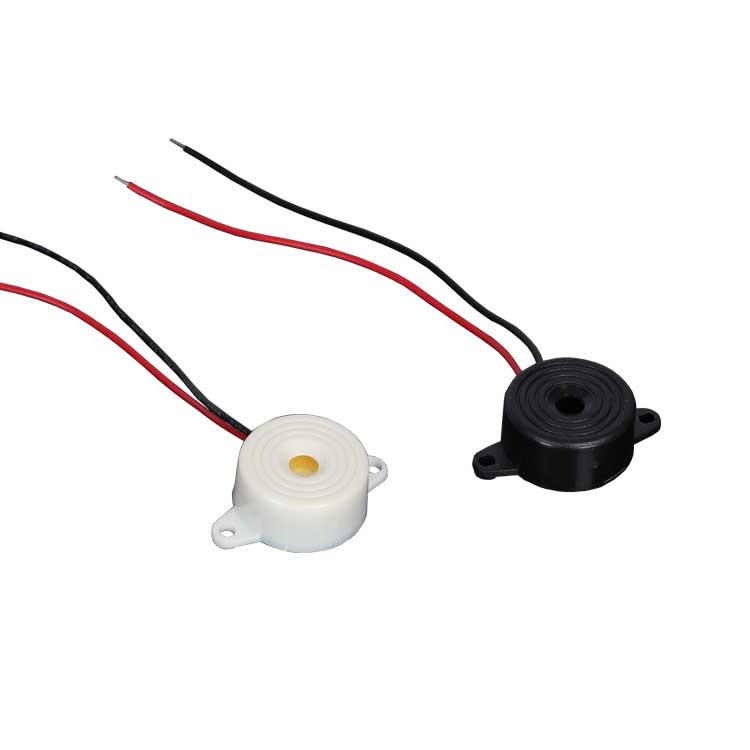
Piezo vs. Magnetic: Head-to-Head
Jiangsu HUAWHA Electronics Co., Ltd. manufactures both SMD piezo buzzers and magnetic buzzers, but for compact, low-power designs, the piezo advantage is decisive. The table below summarizes the fundamental differences in transduction, impedance, and drive requirements.
Aspect | SMD Piezo Buzzer | SMD Magnetic Buzzer |
|---|---|---|
Transduction | Piezoelectric effect | Electromagnetic force |
Impedance | Capacitive (10–30 nF) | Inductive (8–150 Ω) |
Current Draw | < 1 mA | 30–50 mA |
Power Consumption | ~1–3 mW | 90–150 mW |
External Components | 0–1 (GPIO direct drive) | 4–5 (transistor, diode, resistors, cap) |
EMI | Negligible magnetic field | Strong coil switching field |
You can rely on these fundamental differences to guide early-stage architecture decisions before committing to a specific BOM.
Critical Parameter Comparison
Power Consumption and Battery Life
In a CR2032 coin-cell-powered IoT sensor that beeps for 100 ms per minute, a magnetic buzzer's 30–50 mA peak current can collapse the battery voltage unless you add a large bulk capacitor. The piezo buzzer eliminates this problem entirely—its near-zero DC current simplifies power management and extends battery life. HUAWHA's 3V and 5V SMD piezo buzzers are specifically optimized for battery-powered wearables and IoT devices, allowing you to confidently omit bulky power conditioning components.
Tip: When evaluating buzzers for coin-cell applications, always check the peak current specification, not just the rated voltage. A magnetic buzzer rated at 3V may still draw enough instantaneous current to brown out your microcontroller.
PCB Space and Component Height
SMD piezo buzzers are inherently low-profile. Because the acoustic element is a flat ceramic-on-metal laminate, package heights range from 2.5 mm to 5 mm. Magnetic buzzers must accommodate a coil, magnet, and diaphragm, resulting in heights rarely below 5.5 mm. Width is equally critical—piezo buzzers are available with widths as low as 4 mm to 9 mm, making them the only viable choice for blood glucose meters, clinical thermometers, and portable terminals.
Buzzer Type | Footprint (mm) | Height (mm) | Weight (g) |
|---|---|---|---|
SMD Piezo | 9.0 × 9.0 | 3.0 | 0.5 |
SMD Piezo | 12.0 × 12.0 | 3.5 | 0.9 |
SMD Magnetic | 12.0 × 12.0 | 6.5 | 1.8 |
SMD Magnetic | 16.0 × 16.0 | 8.0 | 3.5 |
HUAWHA's miniature SMD piezo buzzer portfolio operates within the 4–9 mm width envelope, with package heights engineered to fit ultra-thin enclosures typical of portable terminals and wearable monitors.
Drive Circuit Topologies
Magnetic Buzzer Drive Requirements
A magnetic buzzer requires at least four external components: an NPN transistor (or N-channel MOSFET), a freewheeling Schottky diode, a base/gate resistor, and a large decoupling capacitor close to the buzzer supply. If the microcontroller GPIO cannot source enough base current, you may need an additional pre-driver stage. This component count adds to your BOM, consumes feeder slots on the pick-and-place machine, and occupies precious PCB real estate.
Piezo Buzzer Drive: Three Paths to Simplicity
The SMD piezo buzzer offers three drive approaches, each with a lower component count than the magnetic equivalent:
Path A – Direct GPIO Drive: For 3.3V/5V systems, a microcontroller can drive the piezo directly with a push-pull square wave. You only need an optional series resistor (10–100 Ω). Component count: 0–1 parts.
Path B – Single-Transistor Boost: For low-voltage systems (1.8V core), add one NPN transistor, one inductor (1–10 mH), and one fast-recovery diode. This topology generates 20–30 Vpp from a 1.8V supply.
Path C – Integrated Driver IC: For multi-tone melodies or industrial temperature ranges, a dedicated piezo driver IC in a SOT-23 or DFN package integrates the boost converter and waveform generator.
Note: HUAWHA's piezo buzzers support standard operating voltages from 3V to 24V DC. Choose 3V or 5V models for battery-powered IoT and wearables, 12V versions for automotive and industrial controls, or 24V options for heavy machinery. Each variant is developed with the target voltage's drive requirements in mind, simplifying your topology selection.
BOM Cost Comparison
BOM Line Item | SMD Piezo (Path A) | SMD Piezo (Path B) | SMD Magnetic |
|---|---|---|---|
Buzzer Unit Cost | Medium | Medium | Medium-High |
Transistor | 0 | 1 | 1 |
Diode | 0 | 1 | 1 |
Resistors | 1 (optional) | 1 | 2 |
Inductor | 0 | 1 | 0 |
Bulk Capacitor | 0 | 1 | 1 (large) |
Total Extra Parts | 0–1 | 4–5 | 4–5 |
The piezo Path A configuration completely eliminates external components, directly reducing placement costs and pick-and-place machine feeder slots.
Design-for-Manufacturing Advantages
SMD Compatibility and Assembly Efficiency
Traditional magnetic buzzers often come in through-hole packages, requiring hand soldering or wave soldering that adds process steps and inconsistency. SMD piezo buzzers are fully compatible with standard reflow soldering profiles—they can be placed by high-speed machines alongside resistors and capacitors, with no secondary operations. This unified SMT process eliminates hand-soldering stations, wave solder pallets, and post-assembly cleaning.
Acoustic Performance Consistency
Piezo ceramic elements manufactured via thick-film processes exhibit tightly controlled resonant frequencies and capacitances. When combined with a rigid SMD housing, part-to-part SPL variation is typically less than ±3 dB. Magnetic buzzers, with moving coil assemblies and spring-suspended diaphragms, can show wider variation due to mechanical tolerances. This consistency is achieved through disciplined manufacturing control. HUAWHA's production lines, operating under ISO 9001, ISO 14001, and QS 9000 certifications, are equipped with advanced audio analyzers for comprehensive incoming, in-process, and final testing. With production capacity reaching 7 to 9 million pieces monthly, QC staff strictly oversees every step—from piezoelectric buzzer design and purchasing through to final testing.
Tip: For products requiring regulatory compliance (e.g., medical alarms with minimum SPL thresholds), the piezo's consistency reduces the need for 100% incoming inspection and end-of-line acoustic testing, saving production time and cost.
PCB Space Savings: A Real-World Example
For a Bluetooth tracker on a 25 mm × 25 mm PCB, a magnetic buzzer solution (12×12 mm footprint plus transistor, diode, two resistors, and an 8 mm diameter bulk capacitor) occupies approximately 200 mm². An SMD piezo solution using Path A (9×9 mm footprint plus one optional 0402 resistor) occupies only 82 mm²—a PCB space saving of over 50%. This reclaimed area can be used for a larger antenna, an additional sensor, or simply shrinking the enclosure to reduce plastics cost.
Field Reliability Without Moving Coils
Piezo buzzers have no coils, springs, or magnetic gaps susceptible to contamination. The acoustic element is bonded directly to the housing. In high-humidity, dusty, or high-vibration environments such as industrial HMIs and outdoor alarms, piezo devices demonstrate higher field reliability. Magnetic buzzers can suffer from corrosion, stiction, or magnetic debris attraction. All HUAWHA piezoelectric buzzers carry CE mark and RoHS approvals, and undergo rigorous testing for reliability across temperature extremes and voltage fluctuations—directly translating to field longevity and lower warranty costs.
Application Scenarios
The following table summarizes where SMD piezo buzzers dominate and how HUAWHA's portfolio addresses each scenario:
Application | Key Requirement | Why SMD Piezo Wins | HUAWHA Solution |
|---|---|---|---|
Blood Glucose Meters / Thermometers | Ultra-compact, medical-safe, battery-operated | 4–9 mm width, negligible EMI,<1 mW power | Miniature SMD piezo with CE, RoHS |
Wearable Health Monitors | Ultra-low power, thin, no magnetic interference | Capacitive drive,<2 mm height | 3V/5V low-voltage buzzers |
Battery-Powered IoT Sensors | Coin-cell or energy-harvesting, 10-year lifetime | <1 mW active power, no DC current | 3V/5V SMD piezo buzzers |
Automotive / Electric Bicycles | High temperature, vibration, AEC-Q | Rated to 105°C, solid-state | 12V piezo buzzer for automotive |
Heavy Machinery | High voltage rails, extreme environments | 24V compatible, no moving coils | 24V piezo buzzer options |
Home Appliances / Alarm Systems | Cost-sensitive, high-volume SMT | Zero external components, high SPL peak | 7–9M pcs/month capacity; CE, RoHS |
Computers / Portable Terminals | Slim designs, global supply | SMD compatibility, minimal footprint | 70% exported to US, SEA, Europe |
You can rely on SMD piezo buzzers across this broad range of applications, from miniature medical wearables to rugged industrial controls.
Design Checklist
Use this checklist during your design review to capture all advantages and avoid common pitfalls when selecting an SMD piezo buzzer:
Resonant Frequency Selection: Match the resonant frequency to your intended tone frequency for maximum SPL. Do not assume a wideband response.
Voltage Budget: Can a GPIO directly supply the required Vpp? HUAWHA offers models across 3V, 5V, 12V, and 24V DC to simplify voltage matching.
Capacitance Measurement: Characterize the piezo's capacitance at your drive voltage—it affects inrush current and boost converter design.
Acoustic Cavity: Check the datasheet for recommended front cavity and back volume. Improper acoustic loading can reduce SPL by 10–15 dB.
SMD Footprint and Stencil: Follow the recommended land pattern precisely. Piezo buzzers often have a central vent hole that must remain unobstructed.
Reflow Compatibility: Confirm peak reflow temperature tolerance (usually 250°C for 30 seconds). Do not use wave soldering for SMD piezo buzzers.
EMI/EMC Consideration: While piezo buzzers generate minimal magnetic fields, sharp square-wave drive edges can couple capacitively. Add a small 22–100 pF capacitor in parallel if radiated emissions are a concern.
Supplier Quality Data: Request Cp/Cpk data for resonant frequency and SPL. Suppliers with ISO 9001, ISO 14001, QS 9000 certifications and advanced in-house audio analyzers can typically provide this data readily.
Total BOM Cost Comparison: Run a full BOM cost including passives and assembly labor. Often the piezo's zero-component drive option delivers the lowest installed cost, even if unit price is slightly higher than a comparable magnetic buzzer.
Global Compliance: Verify CE, RoHS, and any region-specific certifications for your target markets.
Tip: Print this checklist and keep it with your design review documents. A systematic approach at the selection stage prevents costly redesigns later.
Conclusion
Choosing between a piezo and magnetic buzzer is not a simple unit-price comparison. It is a system-level decision that impacts power architecture, PCB layout, procurement complexity, and manufacturing yield. SMD piezo buzzers excel where modern electronic design is trending: miniaturization, energy efficiency, and high-reliability manufacturing. Their ability to be driven directly from a microcontroller pin without external components shrinks the BOM and PCB footprint simultaneously.
When you analyze the total cost of ownership—component count, assembly labor, power supply overhead, and warranty exposure—the SMD piezo buzzer emerges as the clear leader for compact, low-power designs. For OEMs seeking a manufacturing partner with proven scale and quality rigor, HUAWHA offers a comprehensive portfolio spanning 3V to 24V, widths from 4 mm to 9 mm, and applications from medical devices to heavy machinery. With ISO 9001, ISO 14001, and QS 9000 certified production, a monthly capacity of 7 to 9 million pieces, and over 15 years as a trusted supplier to the US, Southeast Asia, and Europe, HUAWHA brings the engineering consistency and global logistics reliability that high-volume product programs demand.
Ready to integrate high-performance SMD piezo buzzers into your next design? Explore HUAWHA's piezo buzzer selection guide or contact our engineering team to request an evaluation kit. With professional engineering support, advanced audio analysis capabilities, and a commitment to quality, Jiangsu HUAWHA Electronics Co., Ltd. looks forward to supporting your next project.