

 doris@jshnbuzzer.com
Piezo vs Electromagnetic: Motors, Actuators and Buzzers Guide
 Sep 28, 2026|
 View:26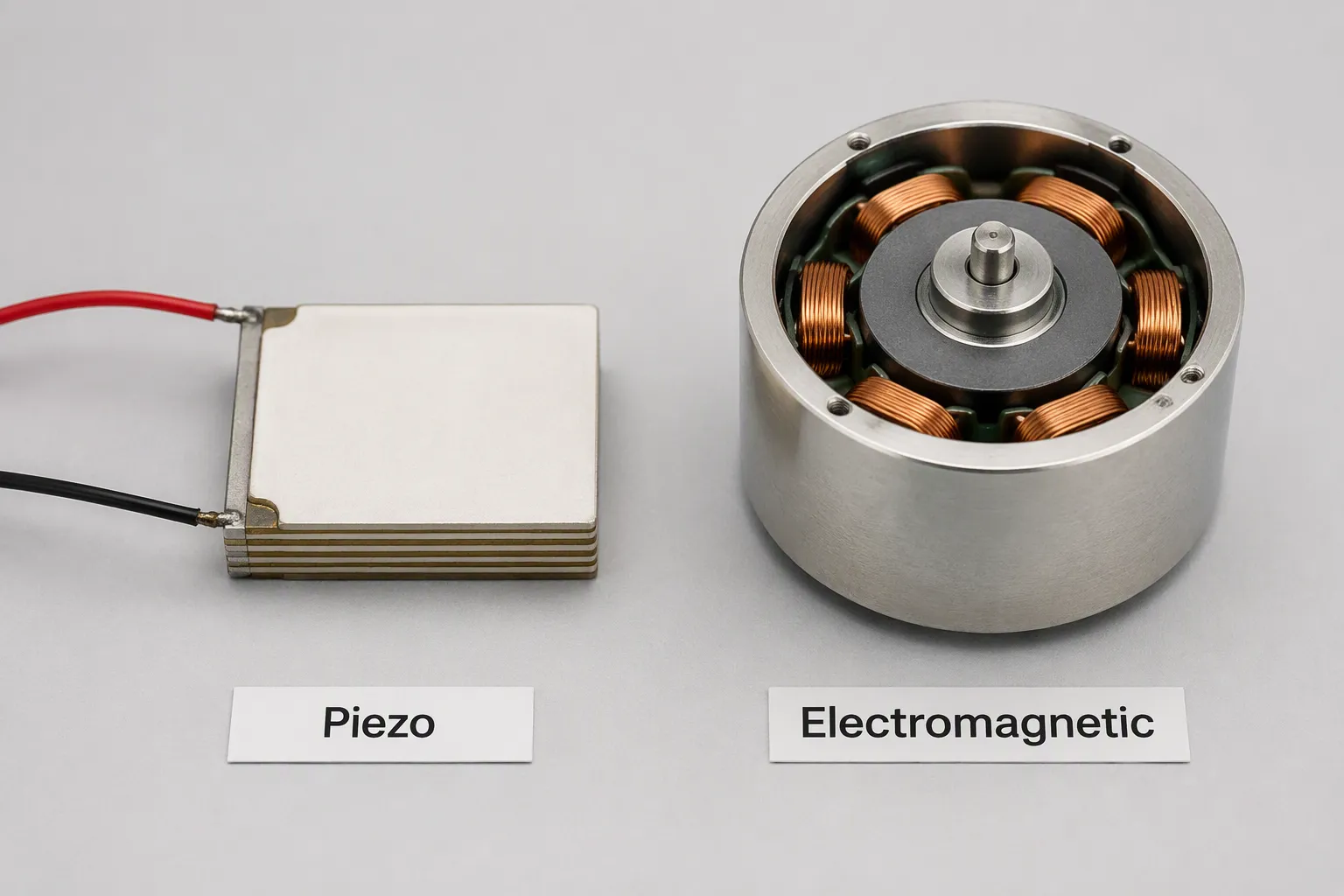
Piezoelectric and electromagnetic technologies are the two pillars of modern electromechanical engineering. While piezo actuators create motion through precise material deformation for nanometer-scale positioning, electromagnetic drives generate force from magnetic fields to handle larger, high-speed motion. However, beyond precision motors, these exact same physical principles power the world's most critical acoustic components: piezo and electromagnetic buzzers.
The global piezoelectric market is expanding rapidly, with the piezoelectric motor and actuator market expected to grow at a 12.1% CAGR through 2033. Simultaneously, the demand for acoustic components (buzzers and transducers) in automotive, medical, and IoT devices is surging. A comprehensive comparison between piezo and electromagnetic technologies must examine both their roles in precision motion control and their dominant applications in acoustic feedback.
This guide examines the working principles, performance metrics, and real-world applications of both technologies—from linear motors to magnetic buzzers—helping engineers select the right electromechanical or acoustic component for their specific use case.
Key Takeaways
In Motion Control:Piezo actuators use ceramic deformation for nanometer precision and MRI compatibility. Electromagnetic motors use magnetic fields for long-distance, high-speed travel.
In Acoustics (Buzzers): Piezo buzzers act as capacitive loads, offering ultra-low power consumption and high Sound Pressure Level (SPL). Electromagnetic buzzers act as inductive loads, providing smoother audio profiles at lower drive voltages.
Choose piezo technology for high-precision optics, MRI-safe robotics, and high-decibel outdoor alarms. Choose electromagnetic technology for industrial automation, consumer electronics, and indoor acoustic indicators.
Both technologies have unique strengths. Your application's requirements—whether nanometer positioning or acoustic penetration—determine the best choice.
Piezoelectric Working Principles: Actuators and Transducers
The Piezoelectric Effect and Motion
A piezo actuator or transducer converts electrical energy directly into mechanical displacement. This relies on the inverse piezoelectric effect. Applying voltage to specific ceramic materials causes them to expand or contract. In precision motors, this microscopic motion is amplified. In acoustic buzzers, this rapid deformation vibrates a metal diaphragm to push air and create sound waves.
The direction of motion depends on voltage polarity. When a voltage with the same polarity as the poling voltage is applied, the element elongates. If an alternating voltage (or PWM signal) is applied, the element cyclically lengthens and shortens at the frequency of the signal, converting electrical energy into mechanical vibration.
It was confirmed that when a voltage-generating crystal was exposed to an electric field, it lengthened or shortened according to the polarity of the field and in proportion to the field strength. This behavior was labeled the inverse piezoelectric effect.
Configurations: From Ultrasonic Motors to Buzzers
Piezo components come in several configurations based on the required output (motion vs. sound).
Component Type | Key Attribute & Application |
|---|---|
Ultrasonic Motor | Uses high-frequency resonance for high-torque, low-speed precision motion (e.g., camera lenses, microscopy). |
Inertia (stick-slip) Actuator | Provides nanometer linear stepping for miniature optical alignment. |
Piezo Buzzer / Transducer | Operates at audible resonant frequencies (2kHz-6kHz) to generate high-SPL alarm tones. |
While ultrasonic motors use friction to drive a rotor, piezo buzzers use the same ceramic expansion to displace air. A driving circuit controls the voltage signals these components need. For buzzers, an active piezo buzzer includes an internal oscillator to generate the AC signal automatically, while a passive buzzer requires an external microcontroller to provide a PWM square wave.
Electromagnetic Working Principles: Motors and Sounders
Lorentz Force and Induction
The working principles of electromagnetic devices rely on the Lorentz force and magnetic induction. A magnetic field exerts a force on moving charged particles (current). This principle scales from massive industrial linear motors down to miniature SMD magnetic buzzers.
Since current is essentially a stream of moving, charged particles, it also experiences a force due to a magnetic field. In the case of a current in a magnetic field, the Lorentz force equation becomes: F = I l B Where:
I = current (A)
l = length of wire through the field (m). The direction of the force is derived using the right-hand rule.
Coil, Magnet, and Transducer Setups
In electromagnetic motors, a coil and magnet setup turns this force into rotational torque or linear thrust. In electromagnetic buzzers, the setup is adapted for acoustics:
A fluctuating current passes through a miniature coil.
This generates a changing magnetic field that interacts with a permanent magnet.
The resulting attractive/repulsive force bends a ferromagnetic diaphragm.
The diaphragm's vibration pushes air, creating a smooth, audible tone.
Magnetic buzzers are resistance-driven and inductive. Lower voltage drives the buzzer, but higher current consumption is a trade-off. Because they are inductive loads, engineers must often include a flyback diode in the circuit to prevent back-EMF voltage spikes from damaging the driving IC. This design suits alarms, medical indicators, and consumer electronics where a natural, less harsh sound is preferred.
Performance Comparison: Motion vs. Acoustics
Torque, Speed, and Precision (Motion Control)
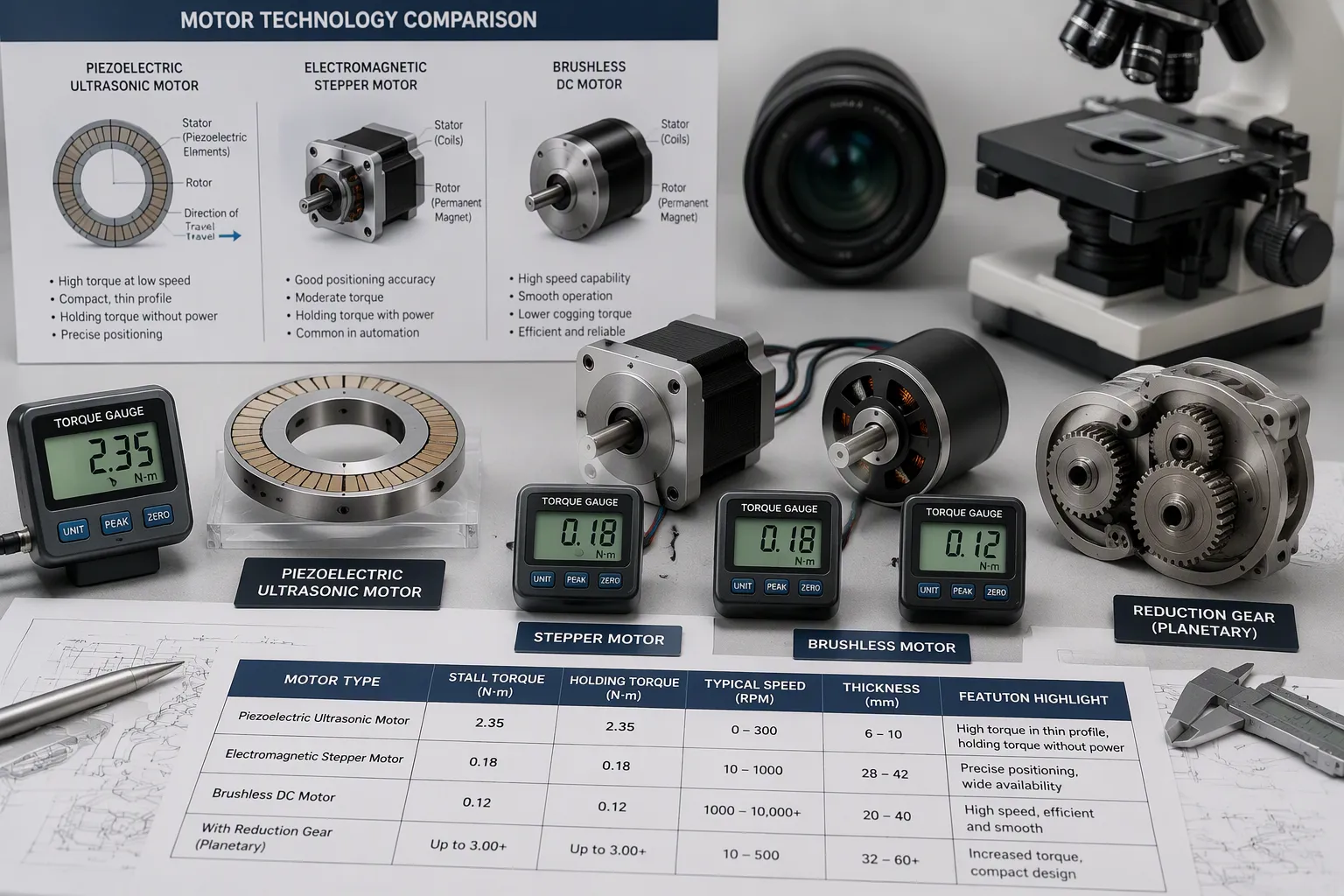
In the realm of actuators, piezoelectric ultrasonic motors deliver greater direct-drive torque than electromagnetic motors of comparable size. Travelling wave ultrasonic motors achieve high torque-to-size ratios and excel in non-powered holding torque. Electromagnetic stepper and brushless motors, while offering lower direct-drive torque, rely on high speed and reduction gearing to achieve massive mechanical power over long distances.
Device Type | Category | Primary Output | Key Characteristics |
|---|---|---|---|
Travelling Wave Motor | Piezo | 0.03–1.5 Nm | High precision, low speed, excellent holding torque. |
Linear Motor | Electromagnetic | High Continuous Force | High speed, long stroke, requires encoders for precision. |
Piezo Buzzer | Piezo Acoustic | High SPL (dB) | Capacitive load, high voltage, ultra-low current draw. |
Magnetic Buzzer | Electromagnetic Acoustic | Moderate SPL (dB) | Inductive load, low voltage, higher current draw. |
MRI Compatibility and Environmental Dynamics
Magnetic resonance imaging (MRI) compatibility sharply separates these technologies in medical robotics. Piezoelectric motors and transducers contain no ferromagnetic materials and generate no electromagnetic interference (EMI). This makes them safe for MRI-guided surgery. Electromagnetic motors and buzzers contain magnets and coils; their magnetic fields interfere with imaging equipment, ruling them out for MRI environments.
The Acoustic Shift: Piezo vs. Magnetic Buzzers
While motors dominate motion control, the most widespread commercial application of these technologies is in acoustic feedback. When designing alarms, medical alerts, or consumer electronics, engineers must choose between piezo and magnetic buzzers.
Piezo Buzzers: High SPL and Low Power
Piezo buzzers handle a broad voltage spectrum (3V to 250V) and consume very low current (often under 10mA). Because they are highly efficient, they are the standard choice for battery-powered IoT devices, smoke detectors, and automotive alarms where piercing high-frequency sound is required to penetrate ambient noise.
Magnetic Buzzers: Smooth Audio and Compact SMD
Magnetic buzzers operate between 1V and 16V but draw more current (20mA to 100mA). Electromagnetic transducers provide a smoother, more natural sound profile, making them ideal for indoor consumer electronics, wearable devices, and medical indicators (like bone-anchored hearing systems) where a harsh piezo tone might be undesirable.
Manufacturers like HUAWHA specialize in this acoustic domain. HUAWHA produces a comprehensive lineup of SMD, electromagnetic, and piezoelectric buzzers (including pin, lead, and active/passive variants). Holding ISO 9001, ISO 13485 (Medical), and IATF 16949 (Automotive) approvals, HUAWHA provides the reliable acoustic components that bridge the gap between complex circuit designs and user feedback.
Advantages and Limitations Summary
Piezo Strengths and Trade-offs
Strengths: Nanometer precision (in actuators), zero magnetic interference (MRI safe), ultra-low power consumption, and massive Sound Pressure Level (in buzzers). They operate reliably in vacuum and extreme temperatures.
Trade-offs: In motors, stroke length is limited without complex mechanical amplification. In buzzers, they require higher drive voltages and produce a narrow, high-frequency tone that some users find harsh.
Electromagnetic Strengths and Trade-offs
Strengths: Long-stroke continuous motion (linear motors), high-speed operation, low-voltage compatibility (3.3V/5V logic), and smooth, wide-frequency audio output (magnetic buzzers).
Trade-offs: Higher current consumption, generation of EMI (electromagnetic interference), inability to operate in MRI rooms, and lower native positioning resolution without expensive encoders.
Applications and Use Cases
Where Piezo Technology Excels
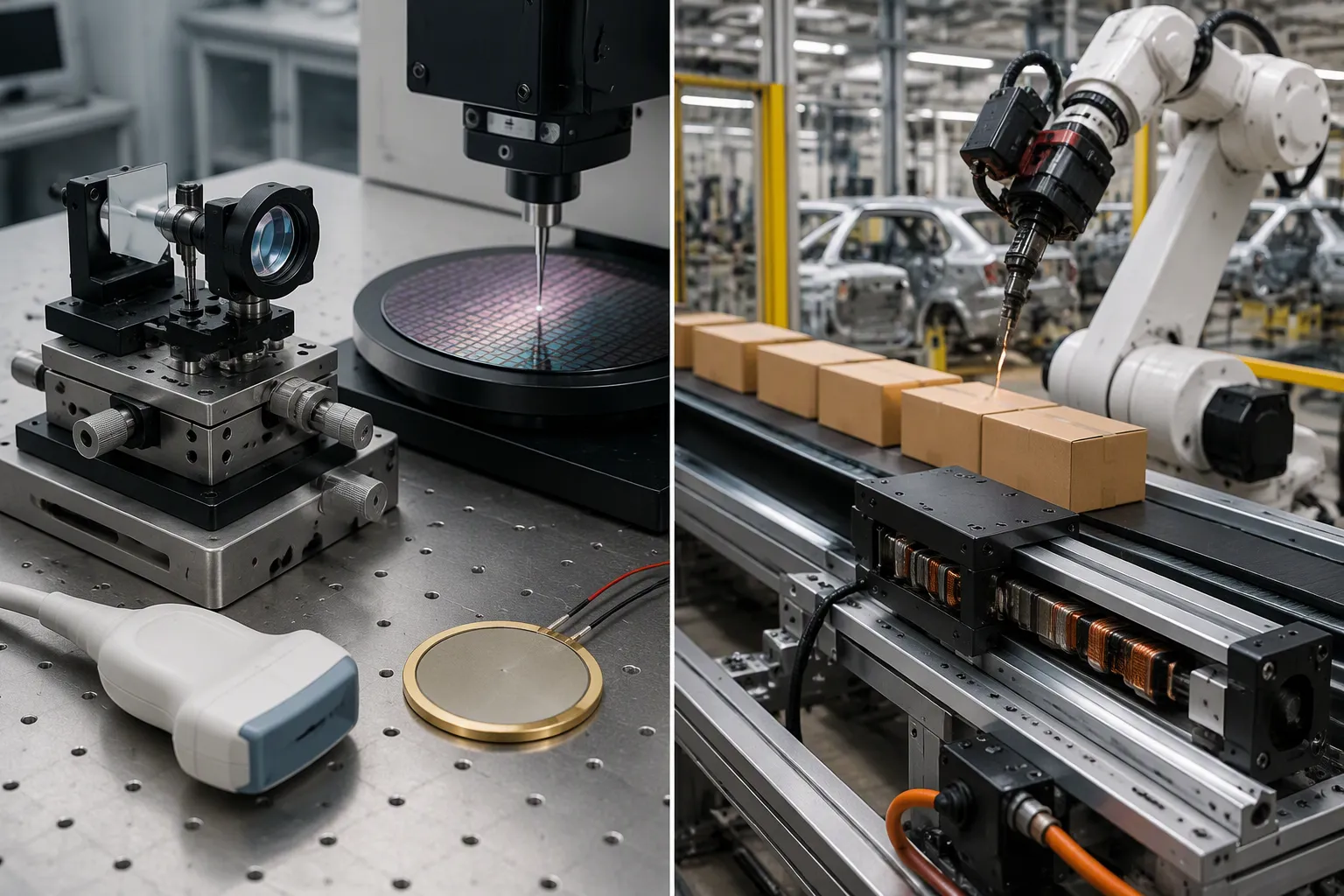
Precision Optics & Semiconductor: Wafer handling and microscope stages using piezo flexure actuators.
Medical Imaging: MRI-safe robotic positioning and diagnostic ultrasound transducers.
Automotive & Industrial Alarms: High-voltage, high-dB piezo buzzers (like HUAWHA's 110dB series) for backup alarms and security systems.
Where Electromagnetic Technology Excels
Industrial Automation: Conveyor systems, CNC machinery, and robotic arms using linear and servo motors.
Consumer Electronics: Smart home appliances, wearables, and computer peripherals using compact SMD magnetic buzzers for UI feedback.
Medical Audio: Hearing aids and patient monitoring indicators requiring soft, non-fatiguing audio tones.
Summary Comparison Table
Engineers need a clear reference when comparing these dual-purpose technologies.
Parameter | Piezo Technology (Motors & Buzzers) | Electromagnetic Technology (Motors & Buzzers) |
|---|---|---|
Physical Principle | Ceramic deformation (Capacitive) | Magnetic induction (Inductive) |
Motion Control | Short stroke, nanometer precision, high holding torque | Long stroke, high speed, continuous rotation |
Acoustic Output | High SPL, sharp tone, high frequency | Moderate SPL, smooth tone, wider frequency |
Power Draw | Extremely Low (Voltage driven) | Moderate/High (Current driven) |
MRI Compatibility | 100% Safe (Non-magnetic) | Incompatible (Magnetic interference) |
Whether you are designing a nanometer-precision optical stage or selecting an active buzzer for a smart thermostat, understanding the underlying physics of piezo and electromagnetic components ensures optimal system reliability.
FAQ
Do piezo actuators and buzzers use the same principle?
Yes. Both rely on the inverse piezoelectric effect. In actuators, the ceramic deformation is used to push a mechanical load (motion). In buzzers, the deformation vibrates a diaphragm to push air (sound).
Why can't electromagnetic buzzers be used in MRI machines?
Electromagnetic buzzers contain permanent magnets and copper coils. In the massive magnetic field of an MRI scanner, these components would become dangerous projectiles and generate severe image artifacts. Piezo components are non-magnetic and MRI-safe.
Which buzzer is better for battery-powered IoT devices?
Piezo buzzers are vastly superior for battery life. They draw micro-amps to low milli-amps of current, whereas magnetic buzzers require continuous tens of milli-amps to maintain the electromagnetic field.
Does HUAWHA manufacture linear motors?
HUAWHA specializes exclusively in the acoustic application of these technologies: Piezo and Electromagnetic Buzzers, Transducers, and Alarms. For precision linear motors, specialized robotics manufacturers are recommended. For high-reliability acoustic components (ISO 13485 / IATF 16949 certified), HUAWHA is the industry leader.
Sourcing High-Reliability Acoustic Components?
Skip the complex motor suppliers. For medical, automotive, and consumer electronics buzzers, partner with HUAWHA. Get datasheets, acoustic simulations, and free samples from our ISO-certified manufacturing facility today.


Recent News
1.Is small piezo buzzer active or passive ?
2023-05-182.Small Piezo Buzzer: How to Use and Connect It Correctly
2023-07-133.SMD Piezo Buzzer Technology: How It Works, Key Specifications, and Design Pitfalls to Avoid
2026-05-154.10 Reliable Piezoelectric Buzzers for Your Prototyping Needs
2026-09-145.Mechanical vs Piezoelectric Buzzers How to Choose the Right Component
2026-08-10