

 doris@jshnbuzzer.com
10 Reliable Piezoelectric Buzzers for Your Prototyping Needs
 Sep 14, 2026|
 View:1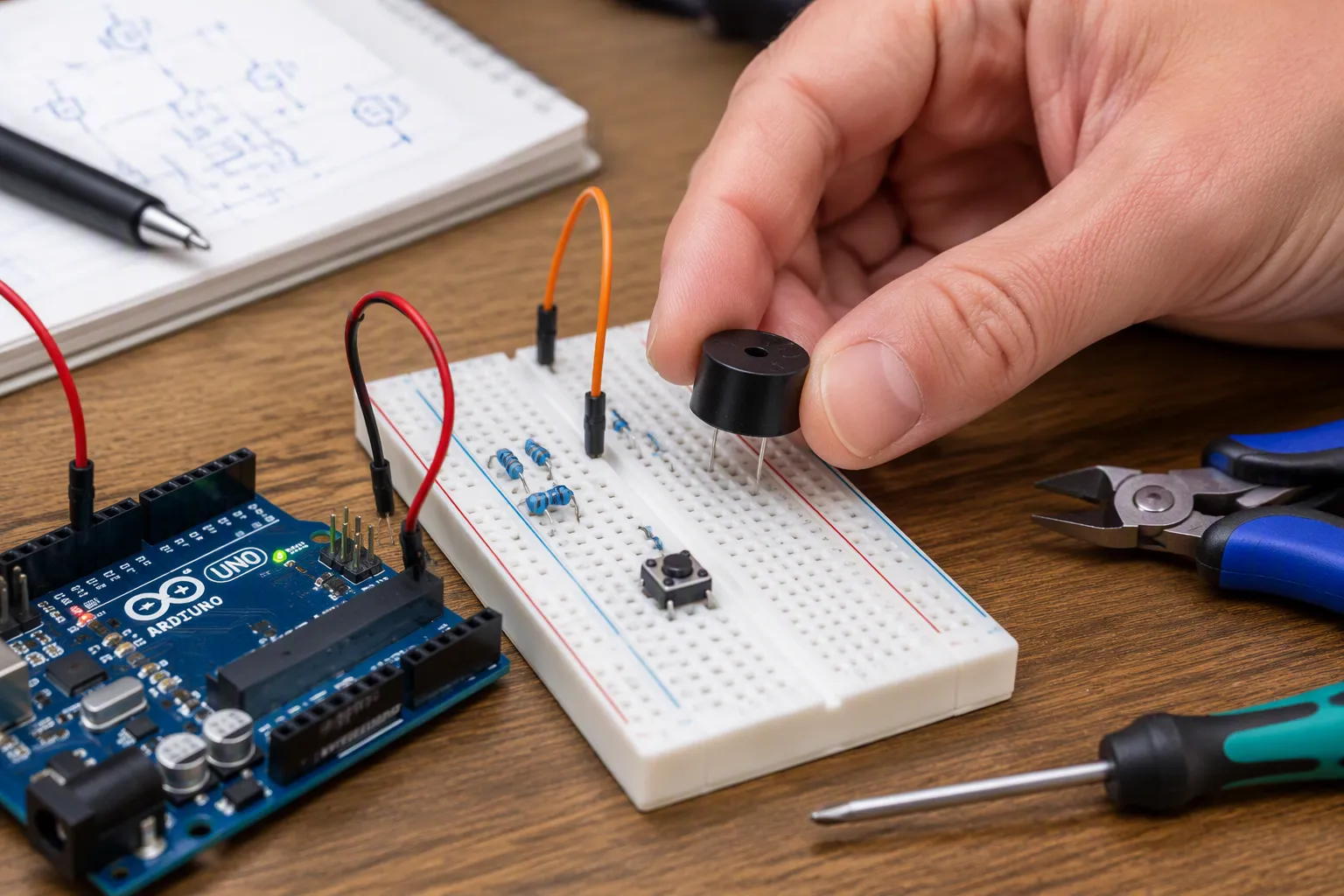
Every electronics project needs a reliable way to sound an alert. A piezoelectric buzzer offers a simple, low-power solution that's easy to integrate. It uses minimal current — typically under 10 mA — making it ideal for battery-powered devices. Piezo buzzers draw less power than magnetic buzzers and produce sharp, high-pitched tones. Understanding the difference between active and passive types is key. Active buzzers have a built-in oscillator, while passive ones need an external signal. They are compact, durable, and work with just a DC voltage. Whether you're building an alarm or a user interface, these buzzers fit the bill. This guide presents five reliable piezoelectric buzzers, focusing on specs and best uses to help you pick the right one for your prototype.
Key Takeaways
Active buzzers have a built-in oscillator and work with DC voltage. Passive buzzers need an external signal to make sound.
Piezoelectric buzzers use very little power, often under 10 mA. This makes them great for battery-powered projects.
Choose a buzzer based on your project's needs. Consider size, voltage, and loudness.
Passive buzzers let you control the frequency for different tones. Active buzzers are simpler to use.
Match the buzzer's specs to your project for the best results. Use the comparison table as a guide.
Top 5 Piezoelectric Buzzer Picks
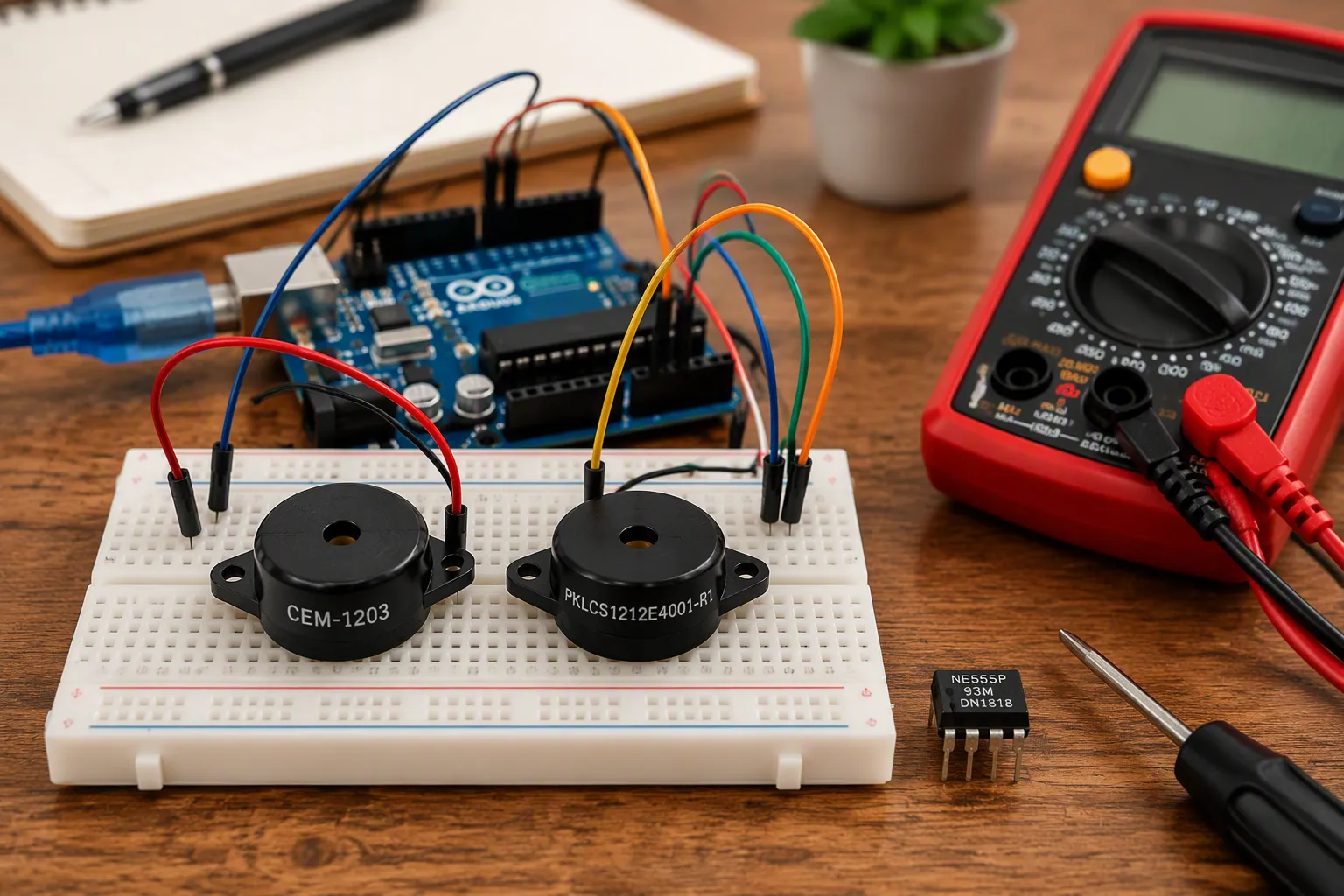
Finding the right buzzer can feel overwhelming. This list cuts through the noise. Each pick includes key specs, pros and cons, and ideal uses. You'll see a mix of active and passive types, including industry standards and flagship models from Jiangsu HUAWHA. That way, you can match the buzzer to your project's exact needs.
1. CUI Devices CEM-1203
The CUI Devices CEM-1203 is a passive piezoelectric buzzer that many hobbyists trust. It needs an external drive signal, so you'll pair it with a microcontroller or a 555 timer. The rated SPL is 85 dB at 10 cm when driven at 3.5 V. That's plenty loud for desktop alerts. Its compact size fits breadboards easily.
Pros include low power draw and a sharp, clear tone. The passive design lets you vary the frequency for different sounds. On the downside, you must supply an AC signal. That adds a little circuit complexity. For beginners, this is a small hurdle. For simple fixed-tone alarms, an active buzzer might be simpler.
Ideal applications include Arduino projects, DIY timers, and user interface feedback. You can program melodies or warning beeps. The CEM-1203 shines when you need flexible sound without high current.
2. Murata PKLCS1212E4001-R1
The Murata PKLCS1212E4001-R1 is another passive piezoelectric buzzer. It operates at a fixed 4 kHz frequency. The SPL reaches 84 dB at 1.5 V, measured at 10 cm. Current consumption is remarkably low: just 0.5 mA at 3 Vo-p, 0.8 mA at 5 Vo-p, and 1.9 mA at 12 Vo-p. The voltage rating is 25 V.
This buzzer excels in tight power budgets. Battery-powered prototypes love its efficiency. The 12 mm-class piezo format is larger than some magnetic transducers. That means you may need to retune your drive circuit. Mechanical stress during handling also requires care. These aren't dealbreakers, just things to plan for.
Ideal uses include portable medical devices, wearable prototypes, and low-power sensors. It's not a drop-in replacement for magnetic buzzers. But when low current matters most, this piezoelectric buzzer delivers.
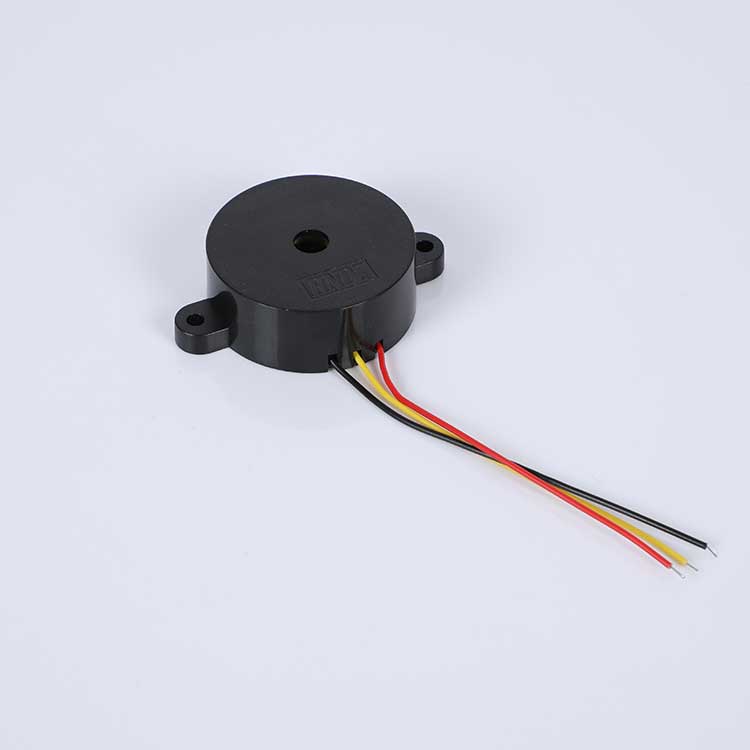
3. Jiangsu HUAWHA 24VDC 110dB Mini Alarm
For serious alarm projects, the Jiangsu HUAWHA 24VDC 110dB Mini Alarm is a premium active piezoelectric buzzer. It runs at 24VDC with an operation range of 18 to 28VAC. The SPL hits at least 110 dB at 0.1 m. Oscillation frequency is 2500 ± 500 Hz. Response time is max 50 mS. It handles temperatures from -20 to +70°C. The unit measures Φ54*53 mm and weighs 50g.
Pros include extreme loudness and simple DC drive. No external oscillator is needed. Backed by HUAWHA's robust manufacturing, it guarantees consistent decibel output across large production batches. The cons are its size and higher voltage requirement. It won't fit tiny enclosures. Ideal for industrial alarms, UPS systems, and electric bicycle warnings. This piezoelectric buzzer is built for attention.
4. Jiangsu HUAWHA 12VDC 85dB Piezo Buzzer
The Jiangsu HUAWHA 12VDC 85dB Piezo Buzzer is a robust active type designed for everyday commercial applications. It produces a clear 85 dB at 12VDC, and its fixed internal tone greatly simplifies wiring for mass production.
Pros: Moderate loudness, extremely easy integration, and rugged construction that withstands harsh environments. As a direct manufacturer, HUAWHA ensures stable supply chains and consistent acoustic performance for this model. Cons: Lacks frequency flexibility compared to passive models.
Ideal applications: Instrumentation, home appliances, automotive dashboards, and electronic toys. It is a reliable, cost-effective choice when you need a standard warning beep without complex drive circuitry.
5. Jiangsu HUAWHA 5Vo-p 75dB SMD Buzzer
This passive SMD piezoelectric buzzer from HUAWHA is engineered for modern, high-density PCBs. It offers a 5Vo-p rated voltage (operation range 1 to 25Vo-p) with a minimum SPL of 75 dB at 0.1 m. Current draw is impressively low at a max of 3 mA. With a capacitance of 12000 ± 30% pF and a resonant frequency of 4000 ± 500 Hz, it operates reliably from -20 to +70°C. The ultra-compact 11 × 9 × 1.7 mm LCP housing weighs just 0.3g.
Pros: Tiny surface-mount footprint, ultra-low current consumption, and fully reflow-soldering friendly. Backed by HUAWHA's automated manufacturing, it guarantees high yield rates for SMT assembly. Cons: Requires an external AC drive signal (PWM).
Ideal applications: Smart wearables, compact IoT nodes, medical wearables, and space-constrained consumer electronics. When board space is at a premium, this SMD piezo buzzer is the ultimate solution.
Piezoelectric Buzzer Comparison Table
Overview of Key Features
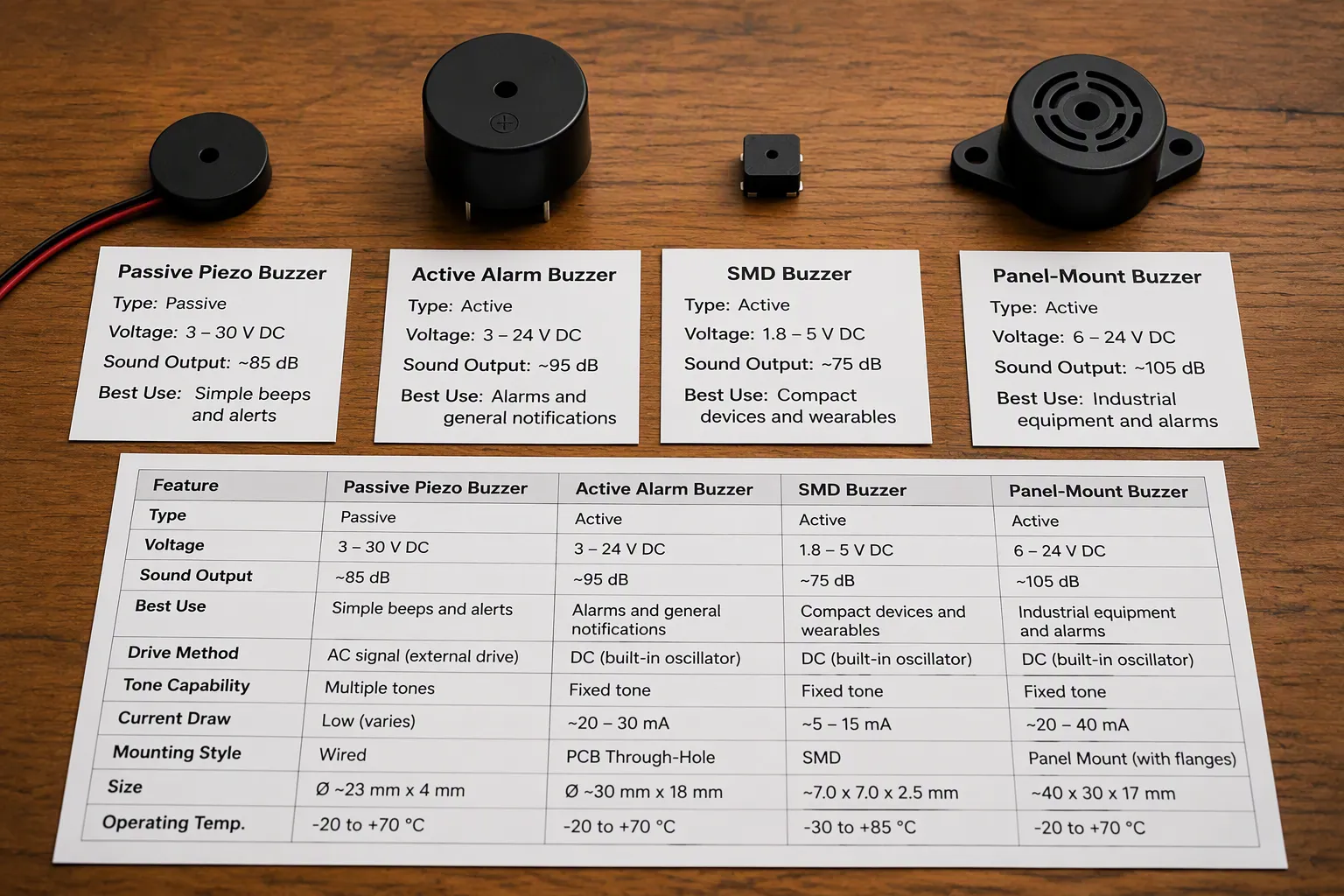
This table puts our top picks for a piezoelectric buzzer side by side. Use it to quickly compare their core specs.
Buzzer Name | Type | Voltage | Sound Output | Best For |
|---|---|---|---|---|
CUI Devices CEM-1203 | Passive | 3.5 V | 85 dB | Arduino projects, melodies |
Murata PKLCS1212E4001-R1 | Passive | 1.5 – 25 V | 84 dB | Battery-powered sensors |
HUAWHA 24VDC 110dB Mini Alarm | Active | 24 VDC | 110 dB | Industrial alarms |
HUAWHA 12VDC 85dB Piezo Buzzer | Active | 12 VDC | 85 dB | Home appliances, toys |
HUAWHA 5Vo-p 75dB SMD Buzzer | Passive | 5 Vo-p | 75 dB | Wearables, IoT nodes |
Engineering Tips for Driving Piezo Buzzers
Understanding how to properly drive your chosen buzzer is just as important as selecting the right model. Here are key engineering considerations:
Drive Signals: Passive buzzers require a PWM (AC) signal from your microcontroller, while active buzzers run on simple DC power.
Frequency Matching: Always match your PWM drive frequency to the buzzer's resonant frequency. This yields the loudest sound output for the least amount of power.
Boosting Volume: Driver circuits matter. Using a full-bridge (H-bridge) driver can double the voltage swing across the piezo element, boosting the sound output by approximately 6 dB.
Size & Mounting: Small SMD buzzers fit wearables, while panel-mount types suit large control panels. Avoid clamping the buzzer casing too tightly, as this dampens vibration and lowers volume. Edge-mounting often provides the best acoustic resonance.
Longevity: Piezo elements are incredibly durable and can easily exceed 100,000 operational hours without mechanical wear.
Making the Final Choice
How do you pick the right one? Start with your volume needs. A loud 110 dB alarm works for industrial settings, while a 75 dB SMD buzzer is perfect for personal devices. Next, look at your power supply: 24V systems match the 24VDC alarm, and 5V systems work well with most passive buzzers.
Watch out for common prototyping mistakes. Never apply pure DC to a passive buzzer—it will only click once. You need a PWM signal at its resonant frequency. Also, avoid clamping the buzzer too tightly in your enclosure. This dampens the vibration and lowers the volume. Mounting it at the edges usually yields the best acoustic resonance.
From Prototype to Mass Production: While prototyping focuses on ease of use, mass production demands supply chain stability and component consistency. When moving from your dev board to a commercial product, partnering with a direct manufacturer like Jiangsu HUAWHA ensures strict quality control, custom acoustic tuning, and reliable bulk supply chains to keep your production lines running smoothly.
Ready to Scale Your Production?
Moving from prototype to mass production? Jiangsu HUAWHA Electronics supports your project at every stage. As a leading piezo buzzer manufacturer, we offer strict quality control, competitive pricing for bulk orders, custom frequency tuning, and global logistics support.
Request a Quote or Free Samples Today
Picking the right piezoelectric buzzer comes down to your project's needs. Think about size, voltage, and how loud you need the sound to be. A tiny wearable calls for the HUAWHA 5Vo-p SMD model. A noisy factory floor demands the 110 dB alarm.
Each pick brings something different. The CUI Devices CEM-1203 works great for general Arduino builds. The Murata model sips power, so it suits battery-powered sensors. The HUAWHA buzzers cover loud alarms and everyday appliances with manufacturing reliability.
Use the comparison table above as your guide. Match the specs to your build, and you'll choose with confidence. Happy prototyping!
FAQ
What's the difference between an active and a passive piezoelectric buzzer?
An active buzzer has a built-in oscillator. You just apply DC voltage and it makes sound. A passive buzzer needs an external AC signal, like a PWM output from your microcontroller. Active types are simpler to wire. Passive types let you control the frequency and create different tones.
Can I drive a passive buzzer directly from an Arduino pin?
Yes, but the volume will be modest. An Arduino pin puts out a square wave at the frequency you program. Match that frequency to the buzzer's resonant frequency for the loudest result. A full-bridge driver can double the voltage swing and boost output by about 6 dB.
What voltage do I need for these buzzers?
It depends on the model. The HUAWHA 24VDC alarm needs 18 to 28VAC. The 12VDC piezo buzzer runs on 12 volts. The 5Vo-p SMD buzzer works from 1 to 25Vo-p. The CUI Devices CEM-1203 is rated at 3.5 V. Always check the datasheet before wiring.
Why does my passive buzzer only click once?
You probably applied pure DC. A passive buzzer needs an oscillating signal to vibrate the piezo element. Without that alternating drive, the element flexes once and stops. Feed it a PWM signal at its resonant frequency, and it will produce a continuous tone.
How loud can a piezoelectric buzzer get?
Output ranges from about 75 dB to 110 dB at close range. The HUAWHA 24VDC Mini Alarm hits at least 110 dB at 0.1 m. The 5Vo-p SMD model produces a minimum of 75 dB at 0.1 m. Louder models suit industrial settings. Quieter ones fit personal devices and wearables.
Does HUAWHA support custom frequency or voltage requirements for OEM projects?
Yes. As a direct manufacturer, Jiangsu HUAWHA offers full customization services. We can tune the resonant frequency, adjust the rated voltage, customize wire lengths, or modify housing materials to meet the specific acoustic and mechanical requirements of your OEM project.
What certifications do HUAWHA buzzers carry for commercial applications?
Our buzzers are manufactured to meet rigorous international standards. Depending on the specific model, HUAWHA products carry certifications such as RoHS, REACH, CE, and UL, making them suitable for automotive, medical, consumer electronics, and industrial applications. Please contact our sales team for specific datasheet certifications.


Recent News
1.Piezo Buzzer - The Power Behind the Sound
2023-03-242.How to Choose a High-Quality Piezo Buzzer China?
2023-06-153.Mechanical vs Piezoelectric Buzzers How to Choose the Right Component
2026-08-104.Piezo vs. Magnetic Buzzers: Why SMD Piezo Leads in Compact Designs
2026-05-195.Step-by-Step Guide to Connecting a Piezo Buzzer
2026-07-20