doris@jshnbuzzer.com

How Buzzers Are Used in Automotive, Consumer Electronics, and More
 Nov 16, 2026|
 View:5
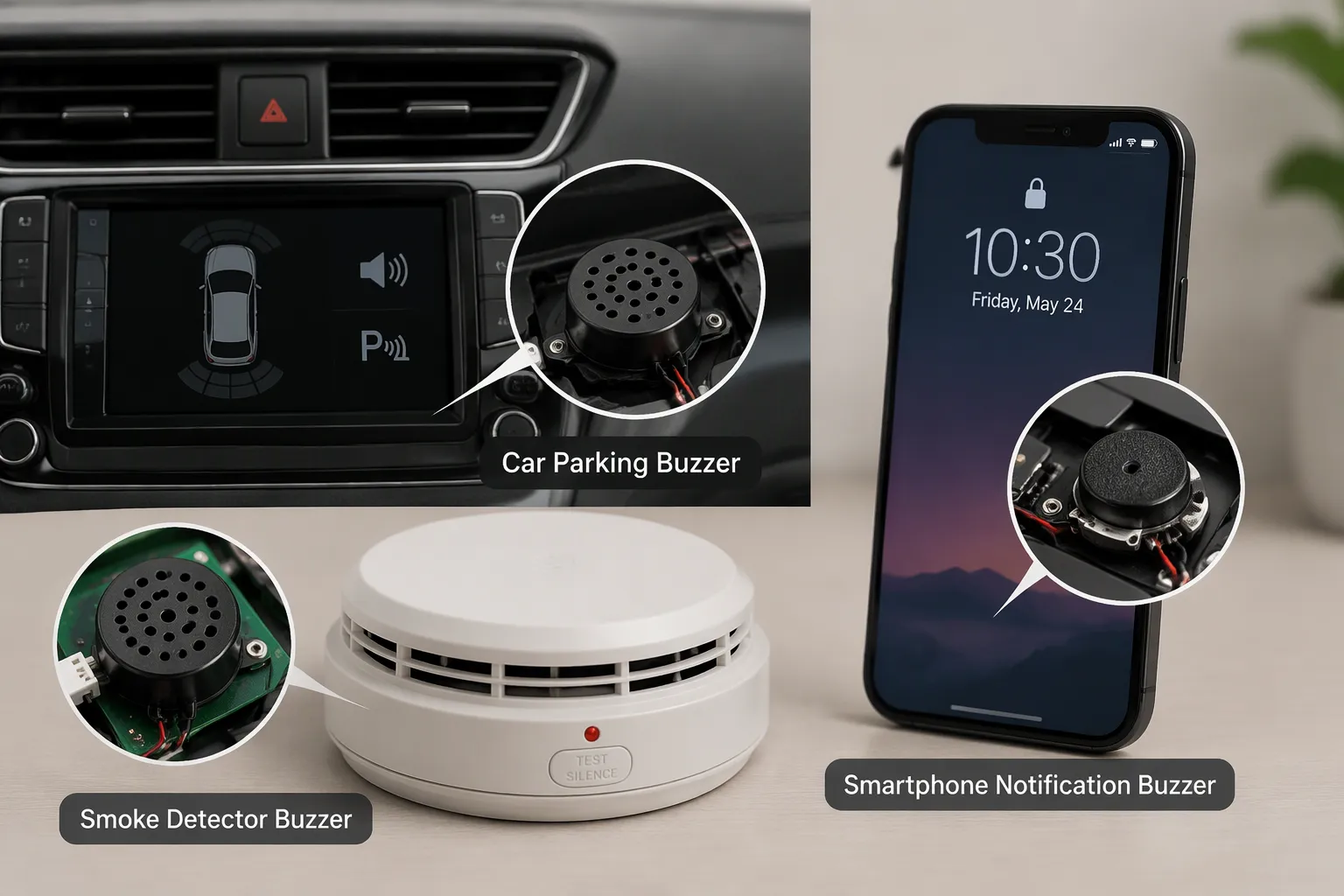
Somewhere in a car, a buzzer is the only part speaking to the driver without a screen. Two seconds of tone say the lane is drifting. A soft chime says the seatbelt is unfastened. Neither asks the driver to look down, and both fail visibly if the part is chosen wrong. That is why buzzer applications are decided by function first and by part type second.
Buzzers serve automotive, consumer electronics, security, healthcare, and industrial equipment markets. Across every sector they do two jobs: safety alerts and user notifications. A warning tone protects an operator; a soft chime confirms an action. Both are buzzer applications before they are product categories.
What changes from one industry to the next is the part, not the principle. Three choices sit on separate axes: the element (piezoelectric or electromagnetic), the drive mode (active with a built-in oscillator, or passive driven by the host MCU), and the package (SMD, pin, or lead). Frequency, sound level, and mounting point then follow from the application. The sections below walk through buzzer applications industry by industry, then reduce the choice to five selection factors and one comparison table.
Key Takeaways
Buzzer applications across the five major industries come down to two roles: safety alerts and user notifications.
Piezoelectric buzzers resonate higher, at 3,500 to 4,000 Hz on the parts in this range, and suit alarms that must cut through noise.
Electromagnetic buzzers run lower, near 2,400 Hz, and cost less per piece for repeat chimes. The drive mode is a separate decision.
Sound pressure is comparable only when the measuring distance is stated. The datasheets quoted here measure at 0.1 m.
Five factors settle the choice in any buzzer application: frequency, sound pressure level, drive circuit, mounting, and environment.
Buzzer Applications in Automotive
Automotive buzzer applications divide into two jobs that share one dashboard: the alert that demands a reaction, and the notification that asks for none.
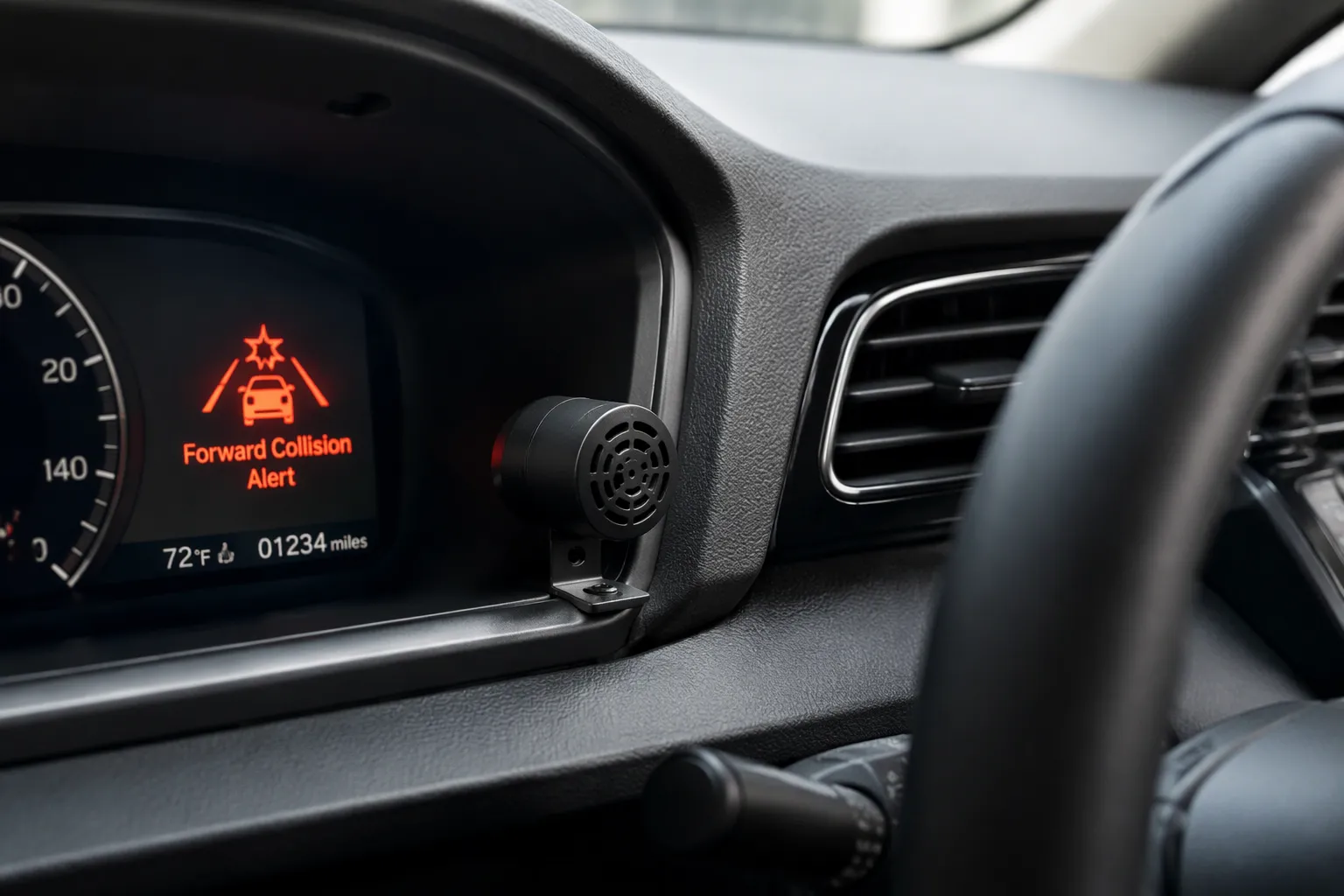
Safety and Driver-Assist Alerts
Safety alerts form the most demanding of the automotive buzzer applications. A warning tone must cut through engine noise, road vibration, and cabin conversation, and drivers respond within moments, so clarity matters more than subtlety.
Piezoelectric buzzers fit high-frequency alarm duties. Their construction produces a sharp tone at the upper end of the working band: the 12 VDC part in this range resonates at 3,500 ± 500 Hz, close to the band where human hearing is most sensitive. Forward-collision warnings, lane-departure alerts, and blind-spot notifications all benefit from that profile. Emergency stop systems on commercial vehicles and electric bicycles rely on the same principle, because a brief high-pitched burst communicates urgency without requiring the driver to read a display.
Rated voltage is only the first gate. A part sold as 12 VDC carries a wider operating window, and a 12 V vehicle bus swings from roughly 9 V during cranking to more than 16 V while charging, with load-dump transients on top of that. The −20 to +75 °C rating covers most cabin positions, though a dash-mounted part sees more heat than a footwell part does. Validate the voltage window, the transient profile, and the temperature range against the platform's test plan before the part goes on a body control module. A general-purpose buzzer is not an automotive-qualified component unless the supplier says so in writing.
Seatbelt reminders and driver-assist chimes follow a different logic. These signals repeat often and must stay tolerable over years of use. Electromagnetic buzzers fit that role. Their lower-frequency output, 2,400 ± 300 Hz on the 24 VDC part listed below, sounds softer and fatigues the ear less, and the element costs less than a piezo disc at volume. Automakers also favor their simpler drive requirements.
The split is practical rather than absolute. A premium vehicle may use piezoelectric components throughout the safety cluster, while an economy platform reserves them for the most critical alarms and deploys electromagnetic units elsewhere. Either way the design rule holds: match the frequency profile to the urgency of the message.
Cabin Notifications
Cabin notifications cover the everyday sounds a driver barely notices, and they are the simplest in the set. A turn-signal tick marks each flash, a parking sensor beeps faster as the bumper nears an obstacle, and a low-fuel or door-ajar chime prompts a quick action. Many platforms now synthesize these tones through the audio system, and volume carries as much weight as tone: federal guidance on in-vehicle device distraction treats a loud or frequent alert as part of the distraction load rather than as a safety feature. Where a discrete part is used instead, it shares three traits: constant repetition, a lower level than an alarm, and no distraction.
HUAWHA's 12 VDC 85 dB piezo buzzer suits several of these roles. At 85 dB measured 0.1 m from the source, the tick sits above the 60 to 70 dB cabin background at the driver's ear, audible without masking speech. The 12 VDC rating matches the nominal bus, and the 23 mm diameter by 10 mm deep housing, 4 g in mass, fits behind an instrument cluster. Designers commonly specify it for cluster reminders and parking-sensor feedback.
The 24 VDC 88 dB mini electromagnetic buzzer fits heavier platforms. Trucks, buses, and commercial fleets commonly run 24 VDC systems. At 88 dB versus 85 dB at 0.1 m the unit is 3 dB louder, about twice the acoustic power and clearly audible over a diesel idle, and its 12 mm can stands 9.5 mm tall at 1.8 g. It handles door-ajar and low-fuel chimes on those platforms without an extra voltage converter. This part is also self-drive, which means the oscillator is built in: it is an active device built on an electromagnetic element, a reminder that element type and drive mode are separate decisions.
Mounting location shapes the choice as much as the electrical rating. A buzzer behind the instrument cluster must project sound toward the driver, and a unit buried in a door panel needs enough output to escape the trim. Compact electromagnetic models fit those spaces, and a 12 mm can is small enough to sit behind a switch blank. Piezoelectric units offer a thin profile for shallow dashboards.
Automotive designers also weigh durability. Cabin temperatures swing widely and vibration never stops, so a buzzer must hold its output across that environment for the life of the vehicle. Selection therefore pairs the right frequency and sound level with a package built for the mounting point, and a part rated −20 to +75 °C suits most cabin buzzer applications but not a vent or an engine bay. That is the pattern across vehicle programs: the mounting point decides the package, and the package decides how much level survives the trip to the driver's ear.
Specifying a part for cabin buzzer applications? Send the mounting position, the target level at 0.1 m, and the voltage window. The engineering team will come back with candidate part numbers and samples.
Get a QuoteBuzzer Applications in Consumer Electronics
Buzzer applications in consumer electronics split along a familiar line: the confirmation the user hears, and the alert the device emits when something changes.
User Feedback
Consumer devices depend on sound to confirm that an action registered: a smart meter beeps when a top-up clears, a printer sounds an out-of-paper tone, a coffee machine signals it is ready. Timers, alarm clocks, toys, and personal devices work the same way. The sound is brief, repeatable, and quiet enough for close-range listening.
The drive method separates two buzzer families. An active buzzer carries a built-in oscillator circuit: apply DC power and it produces a fixed tone with no external components. A passive buzzer needs an external drive signal, so the designer sets frequency and pattern in firmware. Active models simplify the circuit and cut component count at a higher unit price. Passive models cost less per piece and allow several distinct tones from one part, provided the host MCU has a spare PWM channel. The trade is component cost against firmware work.
Home Appliance Alerts
Home appliances use buzzers to mark the end of a cycle or signal a fault, and appliance buzzer applications report both with the same part, which is why the tone pattern carries more weight than the tone itself. A microwave oven chimes when the timer expires, a washing machine beeps at the end of a wash program, and an air conditioner sounds a tone when a filter needs cleaning or a mode changes. These alerts share a common profile: moderate volume, short duration, and reliable operation across years of daily use.
Space constraints drive component selection in this category, because control boards inside appliances are dense. SMD buzzers suit compact designs that mount directly on the PCB surface; HUAWHA's 5 Vo-p 75 dB SMD buzzer measures 11 × 9 × 1.7 mm, draws 3 mA at most, and weighs 0.3 g. Pin buzzers fit through-hole layouts and hold position firmly against vibration; the 5 VDC 85 dB mini pin buzzer uses a 12 mm can at the same 9.5 mm height. Both show up in smart sockets, curtain motors, door and window sensors, gas alarms, and printers. Where a panel needs a louder alarm, the 24 VDC 110 dB unit covers it, but plan the space first: that housing is 54 × 53 mm and 50 g, closer to a sounder than to a component. Buzzer applications on an appliance board are settled by space first and by sound level second.

Buzzer Applications in Security and Building Systems
Security buzzer applications put the part in a fail-loud role, where a silent failure costs more than a false alarm.
Intrusion and Access Alarms
Security buzzer applications depend on sound to deter intruders and alert occupants. An intrusion alarm must announce a breach immediately, a detection system must signal motion, door contact, or glass break, and a signaling device must carry that warning across a building. Each function places different demands on the part.
High-decibel units fill the loudest roles. HUAWHA's 24 VDC 110 dB mini alarm is rated ≥110 dB at 0.1 m, which works out to roughly 90 dB at 1 m in free field after 20 dB of spreading loss over that tenfold distance. That is enough to be heard over machinery in the same room. Reaching the next room takes a separate sounder, because a partition costs far more level than distance does. The 54 × 53 mm housing suits a recessed bracket behind a grille, and installers value the simple two-wire connection.
Lead buzzers also suit panel-mounted layouts. Their attached leads simplify wiring inside crowded enclosures: a technician can route the leads to a terminal block without a separate connector, which removes an assembly step and a failure point at the same time.
Security devices pair high output with durable mounting. A buzzer that fails during an alarm event defeats its purpose, so selection weighs sound pressure level, mounting security, and long-term reliability together rather than in isolation. In these buzzer applications the mounting is worth as much attention as the nominal level.
Buzzer Applications in Healthcare and Industrial Equipment
Healthcare and industrial buzzer applications share the same hardware and diverge on documentation and ambient noise.
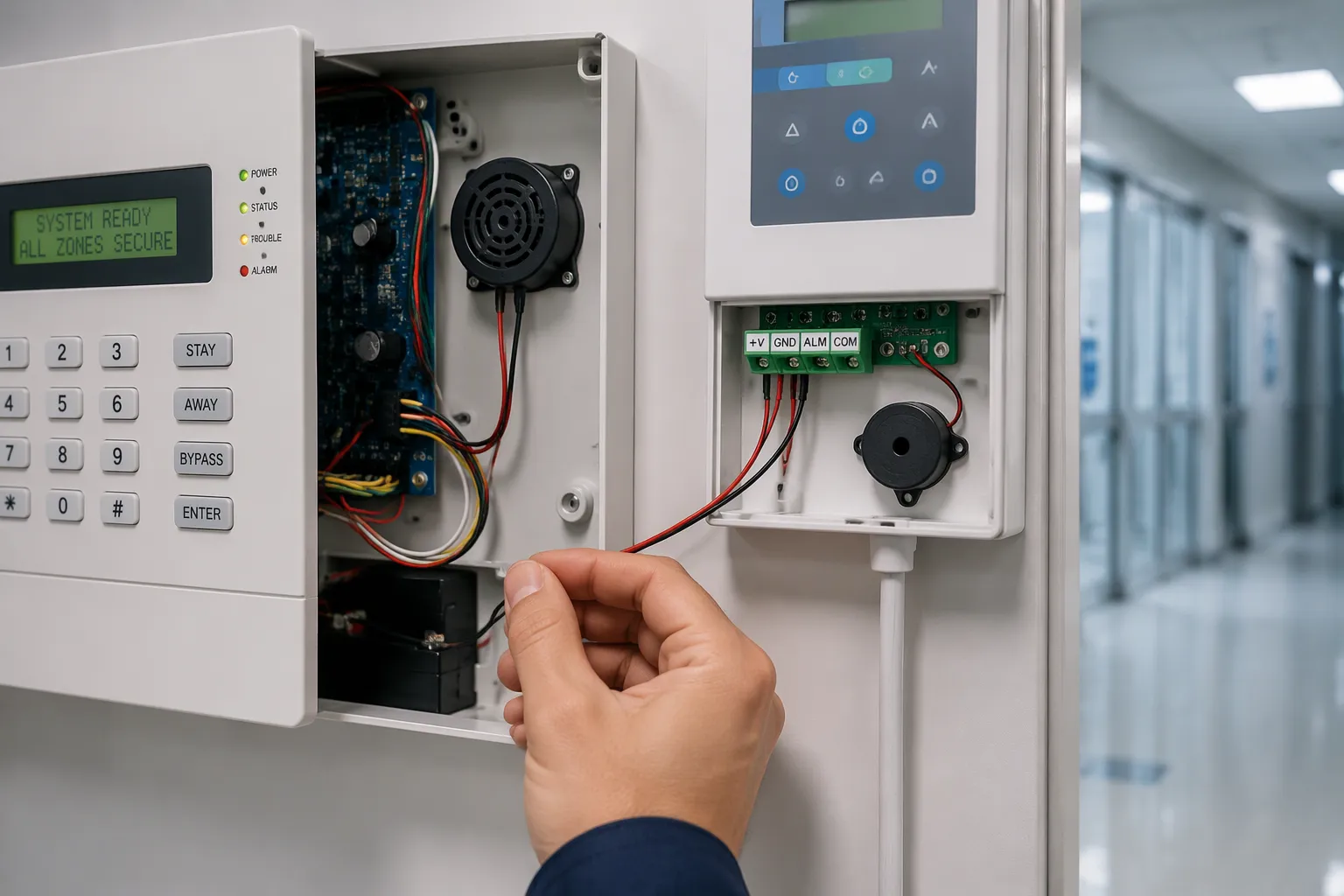
Audible Medical Alarms
Healthcare buzzer applications cover audible alarms and equipment status tones. An alarm must reach the user at a level that is both safe and adjustable, and it must be distinguishable from the other alarms sounding in the same room. That is why the alarm system requirements for medical electrical equipment define separate priority patterns instead of one generic beep, and why the tone design is reviewed alongside the buzzer choice rather than after it.
Documentation matters as much as acoustics in these healthcare buzzer applications. HUAWHA publishes ISO 9001:2015 and ISO 13485:2016 certification along with FDA registration in its company profile. For a medical build, ask for the certificate scope, the issuing body, and the registration number, then add the CE declaration and the RoHS test report for the exact part number. Those documents are what procurement teams audit, and a supplier that answers quickly on them usually answers quickly on samples too.
Industrial Control and Production Lines
Industrial buzzer applications use the same parts for control panels, production lines, and emergency stop systems. A control panel buzzer confirms a mode change or flags a fault code, a line buzzer announces a jam, a completed batch, or a safety condition, and an emergency stop uses a distinct tone to confirm the command registered. Operators learn these tones and respond without reading a screen.
The same parts appear well beyond the factory floor. Uninterruptible power supplies use them for mains-fail and battery-low alerts, instrumentation uses them for limit and overflow warnings, telecom cabinets use them for door and temperature faults, and electronic toys and watches use them for every confirmation sound a child hears. In each case the tone is a status signal rather than an alarm, and the required level follows the ambient noise of the installation site.
That environment, not the principle, separates the two fields, and it is the reason healthcare and industrial buzzer applications rarely settle on one part number. A hospital device runs in a quiet room and needs a clear, moderate tone; a factory floor runs loud and needs a penetrating signal. Match sound pressure level to the ambient noise first, keeping in mind that permissible workplace noise exposure limits set the eight-hour limit at 90 dBA with an action level at 85 dBA, so an alarm sized to beat a 95 dBA floor can push an operator past the limit across a shift. Then confirm the operating temperature range and, where dust or wash-down is involved, ask for an IP-rated housing, since the general-purpose parts in this range carry no IP rating.
Element choice stays flexible across both fields. Piezoelectric models serve high-frequency alarm tones, electromagnetic and active models serve routine status notifications, and compact units cover panels that still need strong output from a small footprint. The function defines the component; the environment refines it. Both sets of buzzer applications reward the same habit: measure the finished assembly, not the bare part.
How to Choose a Buzzer: Element, Drive Mode, Package
Five factors settle most buzzer applications: frequency, sound pressure level, drive circuit, mounting, and environment. The first three follow from the element and drive mode you pick; the last two follow from where the part lives. Every buzzer application in this article resolves through the same five.
Frequency decides whether a tone reads as urgent or routine. Piezo parts in this range resonate between 3,500 and 4,000 Hz and electromagnetic parts between 2,400 and 2,500 Hz, while human hearing is most sensitive between 2 and 5 kHz. That sensitivity is why an alarm in the 2 to 5 kHz band needs a lower level to be noticed, and why a low-pitched buzz at the same sound pressure can feel quieter than it measures.
Sound pressure level is comparable only when the measuring distance is stated, and the figure is normally reported in A-weighted decibels, the weighting that follows the ear's response at moderate levels. The datasheets quoted in this article list minimum levels at 0.1 m: 75 dB for the SMD part, 85 dB for the piezo and pin parts, 88 dB for the 24 VDC electromagnetic part, and ≥110 dB for the panel alarm. Every 10 dB step is a tenfold change in acoustic power, and moving from 0.1 m to 1 m in free field subtracts 20 dB. A specification that says 85 dB without a distance says nothing usable in any buzzer application.
Drive circuit comes next, and it decides the cost of every buzzer application. An active part runs from DC and needs nothing else, while a passive part needs a square wave at its resonant frequency, usually a spare MCU pin through a transistor, with the pattern set in firmware. Current draw separates them further: 3 mA for the SMD part against 30 mA for the electromagnetic and pin parts, which decides whether a battery-powered board can afford the tone at all.
Mounting settles the package. SMD suits reflow on a dense board, pin suits through-hole assembly, and lead suits wired assemblies and crowded enclosures. Environment closes the list: temperature range, moisture, dust, and the acoustic path between the part and the user's ear. A buzzer in a sealed box is a silent buzzer, which is the failure most often found after tooling.
Buzzer application | Element and drive | SPL at 0.1 m | Frequency | Rated voltage | Package | Mass |
|---|---|---|---|---|---|---|
Seatbelt, door-ajar, and cluster reminder | Piezo | 85 dB min | 3,500 ± 500 Hz | 12 VDC | φ23 × 10 mm | 4 g |
Cab status chime on a 24 V platform | Electromagnetic, self-drive | 88 dB min | 2,400 ± 300 Hz | 24 VDC | φ12 × 9.5 mm | 1.8 g |
Appliance and smart-socket board | SMD piezo | 75 dB min | 4,000 ± 500 Hz | 5 Vo-p | 11 × 9 × 1.7 mm | 0.3 g |
Through-hole appliance board | Pin | 85 dB min | 2,400 ± 300 Hz | 5 VDC | φ12 × 9.5 mm | 1.8 g |
Panel, intrusion, and equipment alarm | Alarm sounder | ≥110 dB | 2,500 ± 500 Hz | 24 VDC | 54 × 53 mm | 50 g |
Table 1. Buzzer applications mapped to element type, drive mode, package, and published ratings. Sound pressure values are minimum levels at 0.1 m per the manufacturer datasheets. The five rows cover the buzzer applications described in the sections above.
Supply, Customization, and What to Ask a Supplier
Most buzzer applications end at a part number, not at a datasheet. The variables that decide a production order are lead length, terminal type, housing color, tone frequency, and the sound level the customer measures on the finished assembly rather than on the bench. A supplier who quotes a catalog part against a target level at 0.1 m is easier to work with than one who quotes a price without a measurement condition.
Capacity and paperwork matter in any buzzer application that reaches volume. HUAWHA publishes a monthly output of 1.5 million pieces, ISO 9001:2015 and ISO 13485:2016 certification, FDA registration, CE marking, RoHS compliance, and SGS verification of the factory. Ask for the sample first, measure it in your own enclosure, and only then fix the specification. That sequence catches the sealed-box problem before tooling, which is where most buzzer applications go wrong.

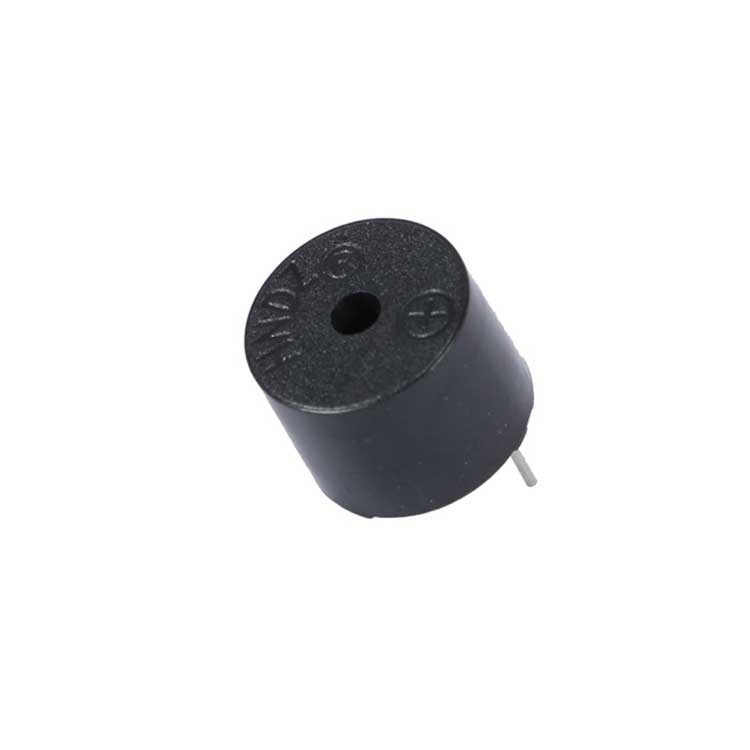
24 VDC 88 dB Mini Electromagnetic Buzzer
Self-drive chime for 24 V platforms. 12 × 9.5 mm, 1.8 g.
View Product
Working through buzzer applications like these? Send the application, the ambient noise around the mounting point, and the target level at 0.1 m. The team will shortlist parts and send samples with the certificate pack.
Contact UsSummary
Buzzer applications differ by industry; the selection logic does not. Start with the role, safety alert or user notification. Pick the element for the frequency band the role needs, then the drive mode for the circuit you can afford, then the package for the assembly process. Close by checking the ambient noise, the temperature range, and the acoustic path in the actual enclosure. That order holds for every buzzer application in this guide.
Those four steps cover most buzzer applications, and once they are settled the part almost chooses itself. Get them wrong and no datasheet will save the design, because the sound a customer hears in a finished product is the only specification that matters.
Clear, reliable sound remains essential in every market these components serve, which is why the buzzer applications listed above keep the part in the design even as devices shrink. HUAWHA supplies piezoelectric, electromagnetic, SMD, pin, and lead buzzers for these buzzer applications, in samples first and in volume after the sample passes.
FAQ
How is the sound pressure level measured?
The datasheets quoted here list minimum levels at 0.1 m, at the rated voltage, with the part driven at its resonant frequency. Change any of those three conditions and the figure moves. A reading at 1 m in free field runs about 20 dB lower, which is why a buzzer application should always be specified with its measuring distance written next to the dB value.
What circuit does an active buzzer need compared with a passive one?
An active part needs DC within its rated range and nothing else, because the oscillator is inside. Both families appear in the buzzer applications covered above. A passive part needs a square wave at its resonant frequency from the host MCU, usually through a transistor to handle the current, and the firmware defines the pulse pattern. Active parts simplify the circuit at a higher unit price; passive parts cost less and allow several tones from one component.
Can an MCU drive a buzzer directly?
Current draw decides whether a buzzer application can drive the part straight from a GPIO pin. The 3 mA SMD part can run from a GPIO pin on most microcontrollers, while the 30 mA electromagnetic and pin parts exceed what a pin should source, so they need a transistor or a driver IC. Running a 30 mA part straight from a GPIO is one of the more common causes of a tone that fades as the battery drops.
Why do piezo and electromagnetic parts sound different at the same dB rating?
Frequency content and directivity explain why two parts inside the same buzzer application can feel different. A piezo part at 3,500 to 4,000 Hz sits in the band where the ear is most sensitive, so it reads as sharper and carries further through background noise. An electromagnetic part at 2,400 to 2,500 Hz reads softer at the same measured level. Two parts with identical dB figures can therefore sit at opposite ends of the perceived urgency scale.
Which certificates can buyers request?
For the buzzer applications above, HUAWHA publishes ISO 9001:2015 and ISO 13485:2016 certification alongside FDA registration, and states CE marking and RoHS compliance for the buzzer range, with SGS verification of the factory. Ask for the certificate scope, the issuing body, the registration number, and the RoHS report for the exact part number you are approving.
What about custom lead lengths, terminals, and tones?
Custom buzzer applications usually change lead length, terminal type, and housing color, while the tone is set by frequency and drive pattern rather than by the housing. Confirm the target level in your own enclosure before fixing the specification, because the mounting cavity shifts the measured result by several dB.
References
Permissible workplace noise exposure limits, 29 CFR 1910.95, Occupational Safety and Health Administration.
Alarm system requirements for medical electrical equipment, recognized consensus standard listing, U.S. Food and Drug Administration.
Guidelines for reducing driver distraction from in-vehicle devices, 78 FR 24818, National Highway Traffic Safety Administration.
Measuring sound levels in A-weighted decibels, Noise and Hearing Loss, Centers for Disease Control and Prevention.
Product figures in this article are from the manufacturer's published datasheets and are stated at 0.1 m unless noted otherwise. Free-field distance loses approximately 20 dB from 0.1 m to 1 m and 6 dB for each doubling of distance thereafter.