

 doris@jshnbuzzer.com
Comparing Buzzer Manufacturers for Reliability in 2026
 Oct 09, 2026|
 View:10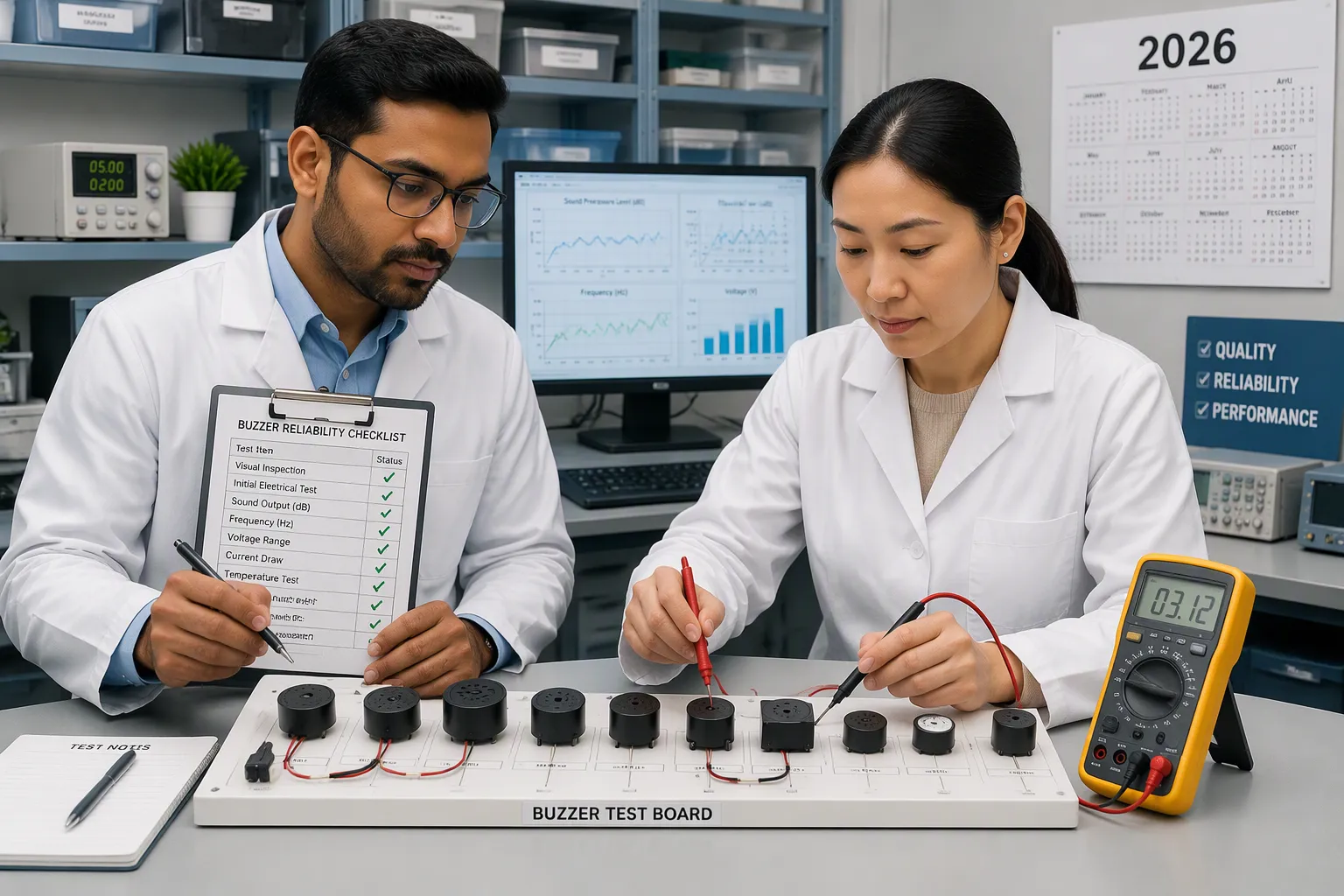
In 2026, the most reliable buzzer manufacturers are Murata, TDK, Jiangsu HUAWHA Electronics, Mallory Sonalert, PUI Audio, Same Sky, and Kingstate. Reliability in a buzzer manufacturer means consistent sound output, compliance with global standards, and dependable long-term supply support. The global buzzer market is valued at USD 805.80 million in 2026, with a projected 5.6% CAGR through 2034. That growth raises the stakes for selecting the right partner. This comparison focuses on performance data, certifications, and support terms. Buyers can use these criteria to shortlist manufacturers and request samples before committing to production.
Key Takeaways
Reliable buzzer manufacturers demonstrate consistent sound output, valid certifications, and dependable supply support.
Buyers should test samples from multiple production batches to verify consistency before large orders.
Match operating voltage, frequency, and sound level to your application's environment for long-term performance.
Compare warranty terms, lead times, and OEM services from several suppliers before making a final choice.
Audit factory certificates, location, and traceability records to separate dependable partners from risky suppliers.
Top Buzzer Manufacturers Compared for Performance and Reliability
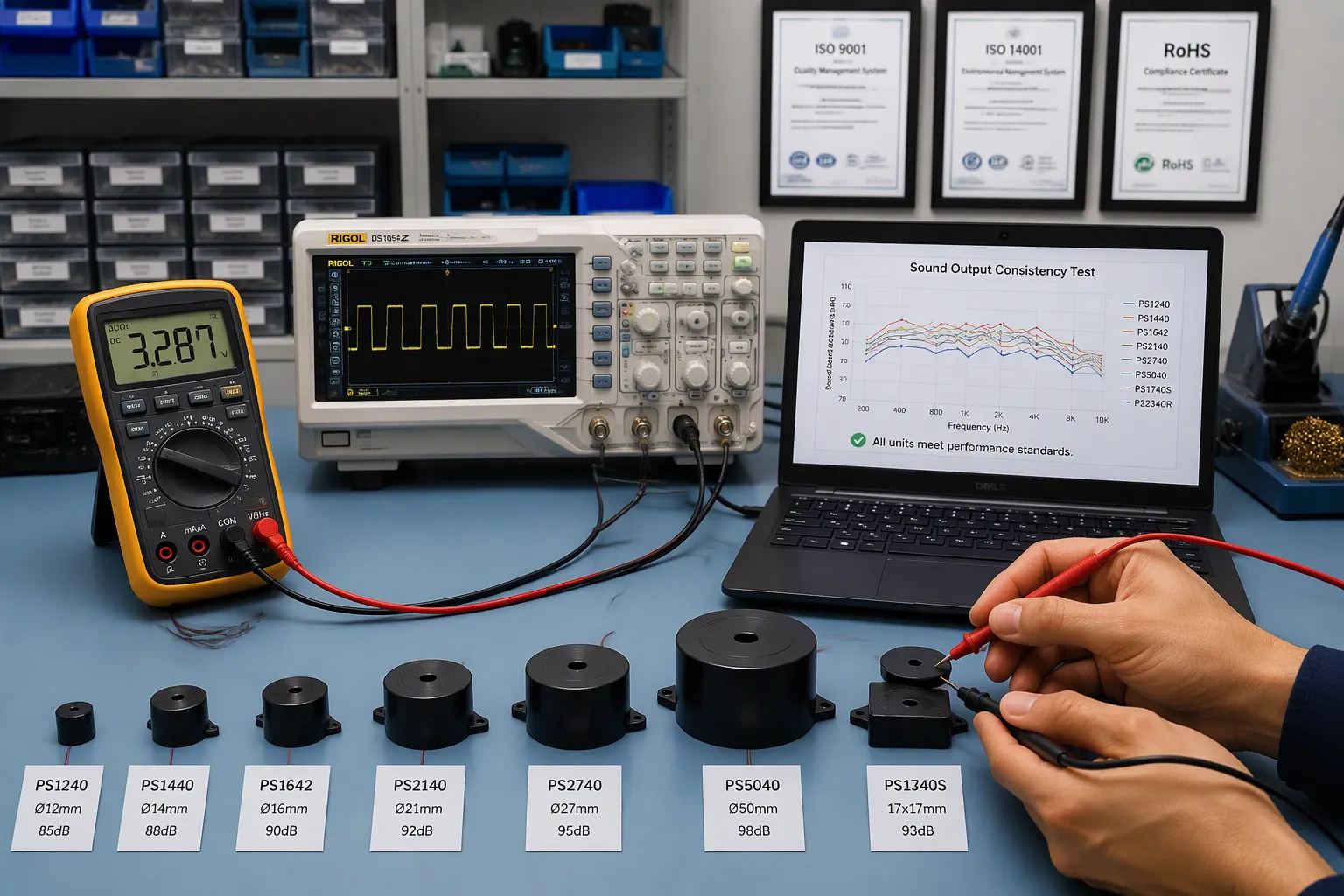
The leading buzzer manufacturers for 2026 are Murata, TDK, Jiangsu HUAWHA Electronics, Mallory Sonalert, PUI Audio, Same Sky, and Kingstate. Each earns a place through distinct strengths in sound output consistency, voltage tolerance, environmental durability, certifications, warranty terms, and global supply reach. This analysis of top buzzer manufacturers compared for performance and reliability draws from secondary information and the Report Prime Research Team (2025). Rankings appear in no particular order.
How the 2026 Rankings Were Built
The evaluation framework weighs technical innovation capabilities, supply chain integration, and long-term customer satisfaction. Supply chain transparency matters greatly, especially for ceramic raw material sourcing. Application-specific certification portfolios also carry weight, such as automotive IATF 16949 versus medical ISO 13485. Technical support infrastructure for drive circuit optimization rounds out the assessment.
The passive piezo buzzer market is moderately concentrated. Diversified Japanese conglomerates, specialized Taiwanese manufacturers, and emerging Chinese suppliers all compete. The top ten vendors account for nearly four-fifths of global revenue. No single firm holds more than one-quarter of total sales. This structure indicates active price and innovation competition. Buyers benefit from genuine choice among capable suppliers.
Top Passive Buzzer Companies Across Key Applications
Passive buzzers require an external drive signal. This design allows firmware-controlled tone and patterns. The suppliers below are strong candidates for passive-buzzer designs. Each demonstrates reliable passive buzzers across demanding applications.
Manufacturer | Reliability and Quality Evidence | Sound and Durability Evidence |
|---|---|---|
Murata | Commitment to quality assurance and testing procedures | Invests in R&D to improve sound output and durability; high sound pressure level and reliable specifications |
TDK | Strict quality control and multiple testing procedures | Invests in R&D to improve sound output and durability; high sound pressure level and reliable specifications |
Jiangsu HUAWHA Electronics | CE and RoHS certified; strong focus on quality and innovation | Proven consistent performance across piezo, magnetic, and SMD buzzers |
Murata piezoelectric sounders serve appliances, consumer devices, automobiles, and industrial equipment. Global distribution and mature process control make Murata a default reference. Buyers should check NRND notices and second-source plans early. TDK offers piezo sounders built on decades of ceramic material expertise. Vertical integration in piezoelectric materials supports stable performance at large volumes. Automotive and industrial customers shortlist TDK for long-term supply agreements and strict change control.
Jiangsu HUAWHA Electronics specializes in passive piezo buzzers, active piezo buzzers, and electromagnetic buzzers. The company holds ISO 9001:2015 and ISO 13485:2016 certifications, plus FDA registration. Products carry CE and RoHS approvals. HUAWHA serves medical devices, automotive electronics, home appliances, security alarms, and IoT terminals. For industrial equipment and automotive alerts, electromagnetic buzzers deliver louder low-frequency output. HUAWHA supplies electromagnetic buzzers with multiple driving modes.
Mallory Sonalert provides panel-mounted audible alarms for industrial equipment. Medical alarms certified to IEC 60601-1-8 serve healthcare signaling. Military and defense applications rely on Mallory's rugged devices. PUI Audio operates as an engineering partner rather than a commodity supplier. In-house prototyping sometimes completes within 24 hours using 3D printers. Same Sky, formerly CUI Devices, offers magnetic buzzers, piezo buzzers, indicators, and transducers. Detailed parametric search and accessible sampling simplify early-stage evaluation. Kingstate positions itself for automotive acoustics alongside micro speakers and receivers.
For consumer electronics and medical devices, passive piezo buzzers are recommended. They are power-efficient, long-lasting, and allow firmware-controlled sound via an external PWM or AC signal. This makes them the most power-efficient choice for battery-powered and compact electronics in 2026. Industrial and automation projects need stronger emphasis on reliability, stable audible signaling, and environmental tolerance. Automotive and safety-related products place greater weight on thermal stability, repeatability, and robust warning performance.
Choosing a Buzzer Manufacturer: Key Metrics That Matter
Frequency, Voltage, and Sound Output
Reliability starts with matching electrical specifications to the application. Underdriven or overdriven buzzers fail early. A piezo buzzer operates from 3V to 250V with current draw under 10 mA. A magnetic buzzer runs from 1.5V to 12V and draws 20 mA to over 60 mA. Resonant frequency ranges from 2 kHz to 6 kHz for piezo types and 1 kHz to 3 kHz for magnetic types. Sound pressure level reaches 85 dB to 120 dB for piezo and 70 dB to 95 dB for magnetic designs.
These key buzzer performance metrics define technology selection. The sound pressure level must exceed ambient noise by 10 to 20 dB. This margin covers aging-related degradation. Off-resonance operation reduces sound output and may cause missed alarms. Voltage droop during alarm events can disrupt microcontroller operation. Over-voltage accelerates aging and can cause failure. Buyers should confirm the dB rating at the actual drive voltage, not the catalog maximum.
Size, Power Draw, and Cost Tradeoffs
SMD buzzers can measure as small as 5mm x 5mm x 2mm. This small footprint fits dense PCB layouts. The small package may limit sound output to 70-80dB at 10cm. Current draw for buzzers generally ranges from 5-30mA. SMD buzzers can draw as low as 0.8mA at 3-5V. Low-current devices reduce power-supply loading and extend battery life. Buzzers requiring more than 20mA may need a transistor or IC driver. Extra driver components increase board space and BOM cost.
Cost comparison should focus on total lifetime cost, not unit price. A low-cost buzzer that fails early creates replacement, downtime, and warranty expenses. SMD buzzers are compatible with automated assembly processes. Automated placement lowers assembly labor and overall manufacturing cost. Piezo buzzers typically consume under 30mA and have lower current consumption than magnetic buzzers. Magnetic buzzers are cost-effective and operate at lower voltages for simple alerting. The final choice depends on price, durability, and performance requirements for each application.
Comparing Leading Buzzer Manufacturers
Global Leaders vs. Specialist Suppliers
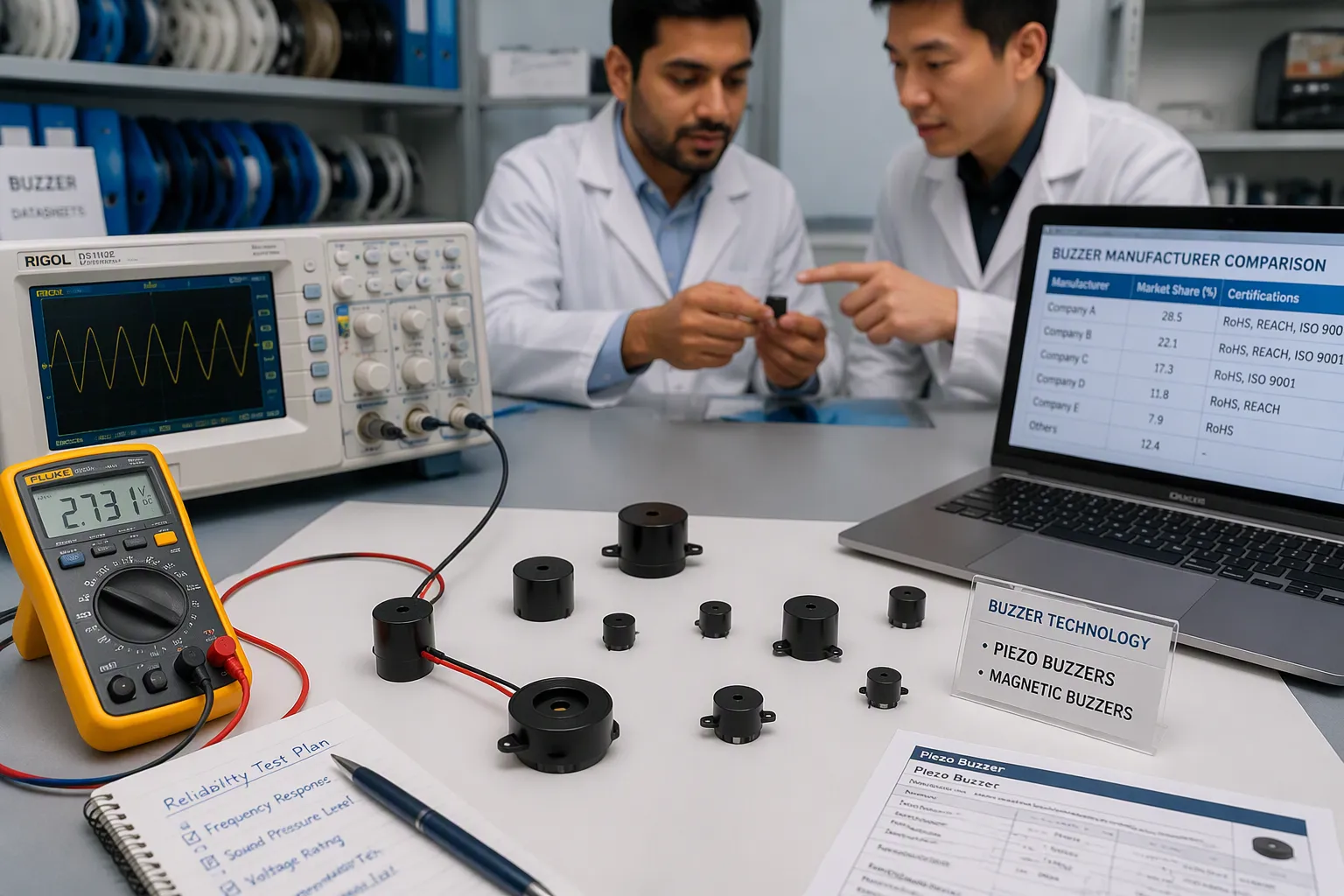
Murata and TDK dominate the global landscape for buzzers. Both Japanese Tier 1 leaders hold premium positions in the Asia-Pacific region, which accounts for 48% of global market revenue. Murata commands an estimated 22% global market share. TDK follows with an estimated 18% share. These two manufacturers set the benchmark for automotive-grade supply and consistent quality.
Dimension | Murata | TDK |
|---|---|---|
Market position | Estimated 22% global market share | Estimated 18% global market share |
Automotive-grade supply | Proprietary frequency-tuning technology; automotive-grade certifications | 2025–2027 supply agreement with a leading Chinese EV manufacturer for 2 million vehicles |
Quality consistency | −40°C to +85°C temperature stability; AEC-Q200 and ISO 26262 certifications | OEM-specific acoustic engineering for custom-tuned alert systems |
TDK secured an explicit supply agreement to provide custom-tuned piezo alert systems for 2 million electric vehicles. Murata competes on durability and acoustic consistency across millions of units. Both companies invest heavily in research and development to improve sound output and environmental tolerance.
Specialist suppliers offer different advantages. Mallory Sonalert provides industrial panel alarms and medical alarms certified to IEC 60601-1-8. PUI Audio operates as an engineering partner with in-house prototyping capabilities. Same Sky, formerly CUI Devices, offers magnetic buzzers and piezo buzzers with strong parametric search tools. Kingstate, an established Taiwan-based manufacturer, focuses on automotive and waterproof micro-speakers.
Strengths, Weaknesses, and Best-Fit Applications
Jiangsu HUAWHA Electronics brings over 15 years of buzzer manufacturing experience to the comparison. The company holds ISO 9001:2015 and ISO 13485:2016 certifications, plus FDA registration. Products carry CE and RoHS approvals. This certification portfolio signals strong quality systems for medical devices, automotive electronics, and industrial equipment.
HUAWHA offers a diverse buzzer portfolio spanning piezo buzzers, magnetic buzzers, and SMD buzzers. Best-selling products include the 24VDC 110dB Mini Alarm and the 12VDC 85dB Piezo Buzzer. These reliable buzzers deliver stable performance and consistent sound output under varying environmental conditions, including high temperature and humidity. The company serves more than 600 cooperative customers across over 100 countries.
A manufacturer strengths and weaknesses comparison reveals clear tradeoffs. Global manufacturers like Murata and TDK provide automotive and industrial certifications critical for safety-sensitive applications. They excel in miniaturization and high-volume reliability. However, their production concentrates heavily in Asia-Pacific, which creates natural-disaster supply risks. Custom engineering cycles also run longer.
Specialist suppliers offer agility for niche volumes. They provide OEM/ODM options and design support tailored to specific requirements. PUI Audio offers customization services for niche reliability needs. Mallory Sonalert targets harsh-environment ruggedness directly. Same Sky accelerates design adoption through accessible sampling. These durable, high-reliability options suit prototyping and specialized applications.
For buyers seeking high-quality buzzers at competitive total lifetime cost, HUAWHA balances certification depth with portfolio breadth. The company supports ODM and OEM customization and holds an import-export license for global distribution. This combination positions HUAWHA as a strong alternative to both global giants and smaller specialist suppliers.
Selecting among these manufacturers depends on application requirements. Automotive programs may prioritize TDK or Murata for their established supply pipelines. Medical device developers may favor Mallory Sonalert for certified alarm systems. Consumer electronics and IoT projects may find HUAWHA or Same Sky better suited to their volume and customization needs.
Certifications, Testing, and Long-Term Reliability
Compliance Standards for Global Markets
Certifications offer objective proof of a manufacturer's quality systems. ISO 9001:2015 certifies consistent production management. ISO 13485:2016 demands stricter process controls for medical components. FDA registration qualifies suppliers for the U.S. healthcare market. CE and RoHS approvals confirm European safety compliance and controlled substance limits.
Different industries need different certification sets. Medical device developers prioritize ISO 13485:2016 and FDA registration. Automotive buyers seek IATF 16949 and AEC-Q200 component qualification. General buyers rely on CE and RoHS as a baseline. HUAWHA holds all these core approvals. Its certification portfolio supports medical, automotive, and industrial customers. These reliability factors guide supplier shortlists.
Durability Testing and Failure Mode Prevention
Durability testing mirrors real-world performance. Reputable manufacturers perform in-house wafer probing for piezo buzzers. Precision-tested components catch material defects before assembly. This prevents premature failure in outdoor and automotive electronics. Sound pressure level measurements verify rated dB output.
Test or condition | What it checks | Failure prevented |
|---|---|---|
Operational life testing | Stable sound output over thousands of cycles; minimal degradation | Premature failure, reduced volume over time |
Mechanical stress / vibration resistance | Withstands shock and constant vibration without loose components | Failures in industrial or automotive environments |
Temperature tolerance | Consistent sound from -20°C to +70°C or higher; no cracking or drift | Thermal cracking, warping, frequency drift |
Moisture and humidity resistance | Sealed housings, moisture-resistant coatings, corrosion-resistant terminals | Failure in humid/outdoor settings, terminal corrosion |
Long-term reliability trials | Continuous operation for days or weeks; reveals sound degradation and fatigue | Hidden field failures, early component fatigue |
BSR testing adds another protection layer. Buzz, squeak, and rattle evaluations use real-life road-profile data and a low-noise vibration system. Intertek's BSR testing covers instrument panels, consoles, cockpits, seats, HVAC assemblies, vent registers, and airbag modules. These evaluations improve product reliability and reduce warranty costs.
Field maintenance also extends service life:
Avoid exposing the buzzer to extreme temperatures, moisture, dust, or contaminants.
Use enclosures for outdoor installations when extra protection is needed.
Provide a stable, appropriate power supply. Incorrect voltage impairs performance.
Inspect wire connections regularly. Repair loose or frayed wires promptly.
Test periodically by activating the driving circuit to confirm sound output.
A well-maintained external-drive unit lasts from several thousand to tens of thousands of hours, depending on operating conditions and quality. Sound output and durability data ultimately determine the final choice.
Warranty, Support, and Global Delivery Performance
Warranty and Technical Support Expectations
Warranty coverage varies widely across buzzer manufacturers. Buyers should compare warranty terms, return policies, and engineering support as commercial criteria, not just product specifications. A reliable supplier confirms the product matches the project technically. Clear communication, stable lead times, and dependable documentation matter throughout the order process.
Engineering support from a dependable piezo buzzer manufacturer includes suitable product families and complete technical specifications. Reliable assistance during sampling and production prevents costly delays. Buyers should also evaluate repeat-order lead-time stability and the availability of compliance documents. These factors protect long-term supply more effectively than a low unit price.
Lead Times, OEM/ODM Services, and Global Reach
Jiangsu HUAWHA Electronics demonstrates strong global delivery performance. The company serves more than 600 cooperative customers across over 100 countries. Over 70% of products are exported to the US, Southeast Asia, and Europe. Monthly capacity reaches 7 to 9 million pieces. This scale supports both prototype runs and high-volume production.
HUAWHA offers ODM and OEM support with custom frequencies, operating voltages from 3V to 24V DC, packaging, and branding. The OEM/ODM process follows six stages: idea sharing, engineering review, prototyping, sample testing, confirmation, and mass production. Each stage validates function, appearance, protection level, and assembly consistency. This structured approach ensures consistent sound output and dependable quality across every order.
Support / Capability | Details |
|---|---|
OEM/ODM services | Custom frequencies, operating voltages (3V–24V DC), packaging, and branding |
Technical consultation | Available for OEM/ODM projects and technical questions |
Phone / WhatsApp | +86-13809014205 |
Factory location | Chenbao Industrial Park, Xinghua, Taizhou City, Jiangsu, China |
Global delivery | 600+ cooperative customers across 100+ countries; over 70% of products exported to the US, Southeast Asia, and Europe |
Monthly capacity | 7–9 million pieces |
Certifications | ISO 9001, ISO 14001, QS 9000, SGS verified, CE, RoHS |
Buyers should request warranty terms, sample test data, and compliance certificates before committing. A manufacturer that provides these documents quickly signals reliable long-term support.
Application-Specific Buzzer Recommendations
Automotive and Industrial Applications
Automotive electronics demand buzzers that resist road vibration, engine harmonics, and temperature swings. Piezoelectric buzzers suit dashboard instrumentation alerts and proximity sensors. These components maintain a stable sound pressure level across a wide thermal range. Manufacturers test automotive buzzers against mechanical stress and vibration to prevent loose components. A buzzer that fails under constant vibration creates safety risks and warranty costs.
Industrial gear relies on buzzers for control panel alerts and handheld testing equipment. Electromagnetic buzzers deliver richer sound quality for machine alert systems. Piezoelectric types serve safety and security devices, including smoke alarms and carbon monoxide detectors. Both types must withstand moisture, dust, and temperature extremes. Buyers should confirm the rated decibel output at the actual drive voltage. This practice prevents missed alarms in noisy factory environments.
Consumer Electronics, IoT, and Medical Devices
Consumer electronics, IoT devices, and medical equipment each impose distinct requirements. The table below maps buzzer types to their best-fit applications.
Buzzer Type | Recommended Applications |
|---|---|
Piezoelectric buzzer | Portable devices; medical devices; healthcare facilities; safety and security; consumer appliances; automotive; industrial gear |
Electromagnetic buzzer | Consumer electronics requiring richer sound quality |
Mechanical buzzer | Toys and basic gadgets |
IoT integration | Smart home systems and connected devices |
Medical devices such as diabetes meters, defibrillators, and infusion pumps require clean sinusoidal response and long-term diaphragm fatigue resistance. Home medical monitors, including continuous glucose monitors and pulse oximeters, depend on fail-safe acoustic alarms. External-drive piezo buzzers draw under 3mA, which supports battery-sensitive IoT sensor nodes. SMD magnetic buzzers operate from 1.5V to 5.0V DC and withstand 260°C lead-free reflow. These specifications meet space-constrained PCB layouts in wearables and smart home devices. Consumer appliances like microwave ovens and white goods use buzzers for functional prompts. Telecommunications equipment, electric bicycles, UPS systems, hearing alarms, instrumentation, toys, and watches all rely on dependable audible signaling. The right buzzer balances sound output, current draw, and environmental tolerance for each application.
Qualifying a Buzzer Manufacturer Before You Commit
Datasheet Review and Sample Testing
Qualification begins with documentation. Request the exact model datasheet and confirm the order code matches the supplied version. Check diameter, supply voltage options, sound-type choices, sound-intensity entries at stated distances, IP rating, and IK rating. If the datasheet omits tone-frequency data, request the actual spectral specifications and measurement conditions. Do not substitute a typical frequency from another catalog.
Sample testing validates datasheet claims. Request at least three samples from different batches. Verify that samples match mass-production materials, sound pressure level, operating voltage, and mounting dimensions. Measure every unit, not just a few, and link the data to the production batch number. This practice confirms sound output consistency across future orders.
Parameter Checked | Purpose for Buyer Qualification |
|---|---|
Sound pressure level (SPL) | Confirms acoustic output consistency between samples and mass production |
Resonant frequency | Verifies stable tone performance across batches |
Operating current | Ensures electrical compatibility with the buyer's circuit |
Batch number | Enables traceability back to the production process |
Quality expert W. Edwards Deming stated, "Quality comes not from inspection, but from the improvement of the production process." His principle remains valuable for buzzer sourcing. A dependable supplier should show process controls, incoming-material checks, traceability records, and documented final testing.
Supplier Audits and Long-Term Agreements
A factory audit reveals more than certificates. Verify the certificate number, issuing body, validity date, and audited site address against the production location on the quotation. Request RoHS evidence that identifies restricted substances and test methods, not just a logo. For CE, confirm the cited directives, standards, product model, and responsible legal entity.
Contract terms protect long-term supply. Discuss minimum order quantity early, since large brands may demand thousands of pieces while flexible factories accept smaller trial runs. Clarify standard lead times, safety-stock policies, and second-source options. Confirm genuine OEM/ODM flexibility for customized voltage, frequency, or housing. Compare tooling fees, customization charges, packaging, and logistics costs. A written schedule with manufacturing and shipping milestones prevents surprises. These reliability factors separate dependable partners from transactional suppliers.
Reliability in buzzer manufacturers stems from three pillars: consistent electrical performance, recognized certifications, and responsive support. Murata, TDK, and HUAWHA each demonstrate these strengths, yet the shortlist is not a final answer. Application-specific requirements decide the winner. A medical device demands ISO 13485 documentation; an automotive dashboard requires vibration-tested buzzer components; a battery-powered IoT node prioritizes low current draw. The manufacturer that wins in one context may fail in another.
Shortlist several candidates, then request datasheets, samples, and warranty terms from those manufacturers. Compare measured sound output at your actual drive voltage, confirm compliance certificate validity, and test samples from multiple batches. These steps convert a promising shortlist into a dependable supply decision.
FAQ
How Long Does a Typical External-Drive Unit Last in Continuous Duty?
External-drive units last from several thousand to tens of thousands of hours under proper operating conditions. Temperature extremes, moisture, and incorrect voltage accelerate degradation. Request operational life test data from buzzer manufacturers before final qualification.
Which Sounder Type Offers Better Long-Term Reliability: Active or Passive?
A passive buzzer typically delivers longer, more consistent service in battery-powered designs. It draws less current and allows firmware-controlled tones. Active types simplify circuit design by generating their own drive signal. Choose based on power budget and control requirements, not assumed durability.
Can One Model Serve Both Indoor and Outdoor Environments?
One model cannot guarantee reliability across all environments. Outdoor electronics demand sealed housings, moisture-resistant coatings, and wider temperature tolerance. Verify IP ratings and thermal test data against your specific installation conditions before selecting a part.
What Testing Data Should I Request Before Approving a New Supplier?
Request sound pressure level measurements at your actual drive voltage, frequency response curves, and vibration test reports. Confirm batch traceability and ask for samples from at least three production batches. These documents reveal consistency far better than marketing claims.
Ready to Source Reliable Buzzers for Your Next Project?
Contact Jiangsu HUAWHA Electronics today for free samples, custom OEM/ODM solutions, and competitive factory-direct pricing.
Contact Us for Free Samples & Quotes


Recent News
1.Top 10 peizo buzzer manufacturers in India 2025
2025-09-082.Top 10 Buzzer Manufacturers in 2025
2026-01-163.Top 10 Piezo Buzzer Manufacturers in China 2026
2026-04-164.How to Choose the Right Buzzer Manufacturer for Your Project
2026-05-255.Top Buzzer Manufacturers Compared for Performance and Reliability
2026-06-02