doris@jshnbuzzer.com

2026 Top 10 Buzzer Manufacturers: OEM Sourcing Guide
 Oct 26, 2026|
 View:3
Top 10 Buzzer Manufacturers to Evaluate in 2026: A Sourcing Guide for OEM Buyers
A buzzer is one of the least expensive parts on a bill of materials, and one of the more frequent sources of late-stage design changes. Two buzzer manufacturers can quote the same 12V part at the same unit price and still deliver different sound pressure at 0.1 m, different behavior at -20 °C, and different paperwork when a customs officer asks for a declaration of conformity.
That gap is why a shortlist built from unit price alone tends to fail during qualification. The ten buzzer manufacturers below are grouped by the technologies they cover and the supply position they occupy, followed by the criteria and the questions that decide which of them fits a given program.
Key Takeaways
Buzzer manufacturers differ mainly in technology coverage, certification scope, and lot-to-lot consistency, not in unit price.
Electromagnetic and piezo buzzers are driven differently: an active buzzer contains its own oscillator, a passive one needs an external drive signal.
Sound pressure figures are only comparable when measurement distance, drive circuit, and rated voltage match.
Compliance runs on two tracks: material rules such as RoHS and REACH, and end-product noise limits that depend on the target market.
Buzzer Technology Narrows the Supplier Pool
Before a buyer can rank buzzer manufacturers, the application has already eliminated most of them. Three technology choices do the eliminating: drive principle, drive mode, and mounting style.
Electromagnetic and piezo buzzers run on different physics
An electromagnetic buzzer moves a diaphragm with a coil and a permanent magnet. A piezo buzzer flexes a ceramic disc when voltage is applied across it. The difference shows up in current draw, frequency stability, and how wide an operating voltage the part tolerates. A 24VDC electromagnetic part can hold 88 dB at 0.1 m on 30 mA, while a 5Vo-p piezo part reaches 75 dB on 3 mA across a 1-25Vo-p range. For battery-powered products, that current difference usually decides the technology before any supplier conversation starts.
Active and passive drive modes change the bill of materials
An active buzzer carries its own oscillator and sounds as soon as DC is applied. A passive buzzer needs an external square wave, which means the design team also owns the drive frequency and the firmware that produces it. A buzzer manufacturer that supplies both modes keeps a redesign from turning into a re-sourcing exercise when the drive architecture changes late in the program.
SMD, pin, and lead mounting decide the assembly route
SMD buzzers sit flat against the board with solder pads at the edges; pin types stand upright on through-hole legs; lead types terminate in a wire harness with a mounting flange. The envelope matters as much as the sound. A 5Vo-p 75 dB SMD part measuring 11 x 9 x 1.7 mm at 0.3 g fits a wearable or a smart socket, while a 12VDC 85 dB lead-type part at φ23 x 10 mm and 4 g suits an alarm panel or an appliance. Buyers who need both envelopes on one purchase order should look for a buzzer manufacturer with SMD and lead lines under one quality system.
Ten Buzzer Manufacturers to Evaluate in 2026
The ten companies below are listed by the role they usually play on an evaluation sheet, not by a ranking. Inclusion reflects publicly documented product coverage, not a quality verdict.
1. Jiangsu HUAWHA Electronics Co., Ltd.
Jiangsu HUAWHA Electronics, which sells under the HNDZ brand from Xinghua in Jiangsu Province, runs a buzzer division covering SMD, electromagnetic, and piezo types, plus pin and lead variants and alarm assemblies. The company publishes CE and RoHS declarations, has its factory verified by SGS, and offers OEM and ODM programs. Its product pages state that more than 70% of output ships to the US, Southeast Asia, and Europe, and quote a monthly productivity figure of 1.5 million pieces.
Datasheet depth is the part that matters in a sourcing decision, and this is where a buzzer manufacturer either supports a design review or slows it down. The 12VDC 85 dB piezo buzzer carries drawing number HND-2310E, oscillates at 3500 ± 500 Hz, responds within 50 ms at the lowest operating voltage, holds its rated sound pressure from -20 to +75 °C, and passes a 10 N terminal pull test. The 24VDC 88 dB electromagnetic part runs 18-28VDC at 2400 ± 300 Hz inside a black PBT housing φ12 x 9.5 mm. The 5Vo-p 75 dB SMD part specifies 12000 ± 30% pF capacitance and a 4000 ± 500 Hz oscillation frequency in an LCP housing.
The published application list covers telecommunications equipment, home appliances, automobiles, electric bicycles, UPS units, instrumentation, electronic toys, and watches. Buyers can review the full range on the buzzer product catalog and route a specification question through the contact page.
2. Murata Manufacturing Co., Ltd.
Murata is a broad-line electronic component supplier whose piezo and electromagnetic buzzer lines sit inside a much larger portfolio. Programs that need automotive-grade documentation and very high volume typically evaluate Murata alongside other tier-one component houses. The trade-off is schedule: a large organization moves at the pace of its qualification queue.
3. TDK Corporation
TDK appears in market coverage of the electromagnetic buzzer segment as one of the larger global players. The fit is usually a premium application where the specification and the qualification paperwork carry more weight than the unit price, such as an automotive warning system that has to clear a platform-level test matrix.
4. Ariose Electronics Co., Ltd.
Ariose, based in Taiwan, focuses specifically on buzzer technology and covers magnetic, piezo, and SMD types. It is a natural candidate for a buyer sourcing from Taiwan or looking for a buzzer manufacturer whose catalog is built entirely around acoustic components rather than a broad component range.
5. Kingstate Electronics Co., Ltd.
Kingstate is usually cited in the piezo and active buzzer segment. It fits mid-volume programs where cost per unit matters and the specification is already settled, so the supplier is being selected on price, lead time, and consistency rather than on engineering support.
6. FBelec Electronics Co., Ltd.
FBelec specializes in SMD and piezo buzzers and presents decades of experience, a full range, and manufacturing scale. The profile suits compact consumer products that need a small footprint, a short turnaround, and a buzzer manufacturer already tooled for reflow-compatible packages.
7. Xinghua Huayu Electronics Co., Ltd.
Xinghua Huayu, which sells under the HYDZ brand, makes acoustic components including magnetic and piezo buzzers. It operates in the same industrial cluster as several other Jiangsu buzzer manufacturers, which shortens sample logistics for buyers already working with suppliers in the region.
8. Kaili Electronic Limited
Kaili is a smaller factory in Changzhou, Jiangsu Province, covering piezo, magnetic, and SMD buzzers. The scale fits niche or cost-sensitive applications rather than high-volume automotive programs, and it is a reasonable starting point for a buyer testing a new enclosure design.
9. ISL Products International, Inc.
ISL Products is a US-based supplier that appears in buzzer manufacturing coverage. It is worth evaluating when the program needs a North American supply chain, a domestic point of contact, or a certification set that is easier to source locally.
10. Soberton Inc.
Soberton appears in market research as an active participant in the buzzer components market. It fits applications that need a recognized supplier rather than the largest one, particularly in low and medium volumes where the purchasing team values a short path to a quote.
Comparing Buzzer Manufacturers on Specification
A comparison table only works when the columns are measurable. The two below separate the technology decision from the part-number decision, so a buyer can see where a buzzer manufacturer is being compared on physics and where it is being compared on execution.
Electromagnetic and piezo buzzers side by side
| Parameter | Electromagnetic buzzer | Piezo buzzer |
|---|---|---|
| Drive principle | Coil and magnet move a diaphragm | Ceramic disc flexes under applied voltage |
| Typical current draw | Higher, tens of mA at rated voltage | Lower, single-digit mA at rated voltage |
| Operating voltage window | Narrower, typically a defined DC band | Wider, often a multiple of rated voltage |
| Frequency control | Set by the drive circuit and mechanical resonance | Set by the disc resonance |
| Common mounting styles | Pin, lead, SMD | SMD, pin, lead |
| Typical applications | Alarm panels, appliances, automotive warnings | Wearables, smart sockets, battery-powered devices |
Three published part numbers from one buzzer manufacturer
| Drawing | Type | Rated voltage | Operating voltage | SPL at 0.1 m | Frequency | Size | Mass |
|---|---|---|---|---|---|---|---|
| HND-2310E | Piezo, lead | 12VDC | 3-24VAC | Min 85 dB | 3500 ± 500 Hz | φ23 x 10 mm | 4 g |
| MLT-1109 | Piezo, SMD | 5Vo-p | 1-25Vo-p | Min 75 dB | 4000 ± 500 Hz | 11 x 9 x 1.7 mm | 0.3 g |
| TMB12A24 | Electromagnetic, pin | 24VDC | 18-28VDC | Min 88 dB | 2400 ± 300 Hz | φ12 x 9.5 mm | 1.8 g |
Need a buzzer manufacturer that publishes full datasheets for every part number? HUAWHA Electronics covers SMD, electromagnetic, and piezo ranges under one quality system.
Get a QuoteFive Criteria That Decide a Buzzer Manufacturer Shortlist
Once the technology is fixed, five criteria separate a workable supplier from a risky one. They apply to any buzzer manufacturer, regardless of size or country of origin.
1. Technology coverage
A supplier that builds electromagnetic, piezo, and SMD parts can absorb a change in drive architecture without a new qualification cycle. A single-technology supplier cannot, and the cost of that limitation usually appears six months later as a second sourcing project.
2. Manufacturing scale and consistency
Scale matters less than repeatability. The useful question is whether the buzzer manufacturer controls its own diaphragm assembly and winding, or assembles from purchased subcomponents. Incoming inspection of finished parts cannot recover consistency that was never built in.
3. Geography and supply chain
China, Taiwan, and the US each imply a different mix of tooling lead time, freight exposure, and documentation practice. None of these is inherently better; the match depends on where the finished product is assembled and which market it ships into.
4. Cost versus qualification burden
A premium component house charges for documentation and traceability, and those costs are real. The comparison should price the whole burden, including the engineering hours a buyer spends closing specification gaps, rather than the unit price on the quotation.
5. Certification and quality documentation
Material compliance is a hard gate. Electrical and electronic equipment sold into the EU must meet the EU restrictions on hazardous substances in electrical equipment, and substances above the registration threshold fall under EU chemical registration requirements. On the acoustic side, a device that emits an alarm tone becomes part of the noise exposure profile of whoever works near it, and in the US that exposure is governed by occupational noise exposure limits. A buzzer manufacturer that can supply declarations and test reports on request removes weeks from a compliance review.
Seven Questions to Ask Before Shortlisting a Buzzer Manufacturer
These questions are worth putting in writing before samples ship. Each one has a specific answer a competent supplier can produce, and a vague answer is itself information.
Which technology does the application actually need?
A magnetic buzzer manufacturer works with coil and magnet assemblies; a piezo supplier works with ceramic discs. The choice follows from current budget, voltage tolerance, and the frequency the alert has to hit. Automotive warning tones and appliance alarms usually land on electromagnetic parts, while battery-powered consumer devices usually land on piezo.
Which specifications actually bind?
Sound pressure level in dB, operating voltage, current draw, oscillation frequency, physical size, and mounting method form the core specification. A buyer should confirm the measurement condition behind every dB figure, because a rating taken at 10 cm and a rating taken at 0.1 m describe very different parts.
What environment will the part see?
Operating temperature range, humidity, vibration, and wash-down exposure all narrow the field. A part rated from -20 to +70 °C is not interchangeable with one rated from -40 to +85 °C, and the datasheet usually states which range holds its rated sound pressure.
Which certifications are mandatory?
RoHS and REACH declarations are the baseline for the EU, ISO 9001 is the usual quality-system expectation, and automotive or medical programs add their own layers. A buzzer manufacturer should be able to name the certificate holder and the issuing body, not just the certificate acronym.
What volume and what cost target?
High-volume, cost-driven programs and low-volume, premium programs point at different suppliers. Asking for a price break schedule at three volume tiers early in the conversation separates a supplier that wants the business from one that is quoting to stay polite.
What lead time can the program tolerate?
Standard parts ship from stock in weeks; custom housings, lead lengths, and drive frequencies add tooling time. A buyer should ask for the lead time on the sample, on the pilot run, and on steady-state production separately, because the three rarely match.
How much customization is required?
OEM and ODM support covers everything from a private label on a standard part to a new acoustic cavity designed around a specific enclosure. The scope of customization determines whether the supplier is a catalog vendor or a development partner, and that distinction changes the contract.
The three parts below come from the same buzzer manufacturer and span the three most common envelopes: a lead-type piezo for panel and appliance work, an SMD piezo for compact battery-powered devices, and a pin-type electromagnetic part for 24V control systems. Each links to its full specification page.

12VDC 85dB Piezo Buzzer
Lead-type piezo, 3500 ± 500 Hz, 23 mm x 10 mm, 4 g.
View Product
5Vo-p 75dB SMD Buzzer
SMD piezo, 1-25Vo-p range, 11 x 9 x 1.7 mm, 0.3 g.
View Product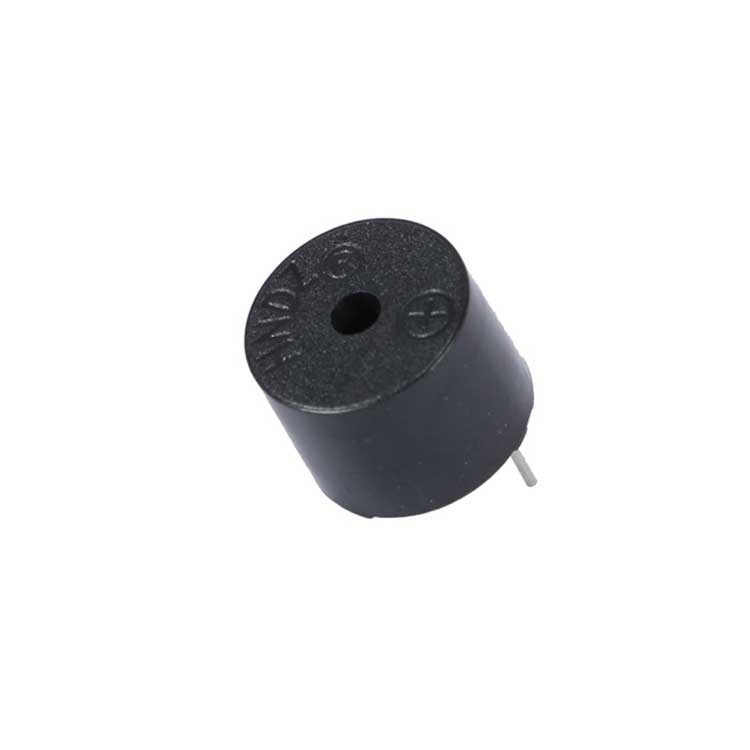
24VDC 88dB Electromagnetic Buzzer
Pin-type electromagnetic, 18-28VDC, 12 mm x 9.5 mm, 1.8 g.
View ProductHave a specification in mind? Send the voltage, target SPL, and enclosure dimensions, and HUAWHA Electronics can confirm whether a standard part fits or a custom build is needed.
Contact UsConclusion
Ten buzzer manufacturers, five criteria, and seven questions are enough to build an evaluation sheet that survives a design review. The shortlist itself matters less than the process: fix the technology first, confirm the measurement conditions behind every dB figure, then price the whole qualification burden rather than the unit cost.
For programs that need SMD, electromagnetic, and piezo ranges from a single buzzer manufacturer, with CE and RoHS declarations and SGS factory verification behind them, HUAWHA Electronics (HNDZ) is worth adding to the shortlist and comparing against the other nine on the criteria above.
FAQ
How do I compare dB ratings from different buzzer manufacturers?
Ask for the measurement distance, the drive circuit, and the rated voltage behind each figure. A rating is only comparable when all three match. Most datasheets specify sound pressure at 0.1 m under a standard drive circuit at rated voltage, and any figure without that context should be treated as indicative.
Does an active buzzer cost more than a passive one?
An active buzzer carries an oscillator circuit, so the part itself usually costs slightly more than a passive equivalent. The comparison changes at the system level, because a passive buzzer shifts the oscillator cost into the drive circuit and the firmware that produces the square wave.
Which certifications should a buzzer manufacturer hold?
RoHS and REACH declarations are the baseline for equipment sold into the EU, and ISO 9001 is the common quality-system expectation. Automotive and medical programs add their own qualification layers. Confirm the certificate holder and the issuing body rather than accepting an acronym on a website.
How long does a custom buzzer sample take?
A standard part usually ships from stock within weeks. A custom housing, lead length, or drive frequency adds tooling time that varies by complexity. Ask for sample, pilot-run, and steady-state lead times separately, since the three rarely match.
What separates a magnetic buzzer manufacturer from a piezo one?
The drive principle. A magnetic buzzer manufacturer builds coil and magnet assemblies, which draw more current but hold frequency well under load. A piezo supplier builds ceramic disc assemblies, which draw less current and tolerate a wider voltage window but depend on the disc resonance for their tone.



Recent News
1.Comparing Buzzer Manufacturers for Reliability in 2026
2026-10-092.Electromagnetic Buzzer Buying Guide for Your Next Project
2026-09-073.10 Reliable Piezoelectric Buzzers for Your Prototyping Needs
2026-09-144.Mechanical vs Piezoelectric Buzzers How to Choose the Right Component
2026-08-105.Active buzzer or passive buzzer which is best for you
2026-07-13